
Jordan, Sam and special guest Chris talk about season two of Archer, what to do about Wee Baby Seamus, and discuss how you get ants. DANGER ZONE!
Got comments about this podcast, or questions you want Sam and Jordan to answer? Well let us know! Follow us on twitter @reviewtobenamed (follow us here), or shoot us an e-mail at reviewtobenamed@gmail.com.
Showing posts with label Sam. Show all posts
Showing posts with label Sam. Show all posts
Wednesday, April 6, 2011

Saturday, April 2, 2011
Random Pop Culture Top Ten List: Top 10 TV Shows to Make it Past the Season Five Mark Without an Abhorrent Drop in Quality
By Jordan and Sam
Random Pop Culture Top 10 List is a (fairly self-explanatory) weekly list in which the Review To Be Named gang take stock of the realm of pop culture, and come up with their Top Ten in a specific category.
There is an unwritten rule of television that five seasons is kind of the perfect length for a television show. Less than that may leave the show feeling incomplete, with remaining loose ends or a rushed feel to it (look, for example, at two cancelled shows, Arrested Development, which is near-perfect but feels rushed toward its end, and Dollhouse which aimed to run five but was cancelled after two and forced to shove four seasons of development into its 13 episode second season). More than five, and the show tends to run off the rails, jumping the shark or losing track of its narrative structure and eventually tarnishing its legacy (look to Scrubs, 24, How I Met Your Mother, Dexter, which will soon join this crowd with its sixth season, or any number of others for examples of this). Plenty of shows have lasted exactly five seasons, and end right when they should have (like The Wire, Six Feet Under, and Angel). Here are a list of ten shows who made it over this mystical lump and kept producing at the same quality for seasons afterwards.
10. Saturday Night Live
The longest running show on the list could have very well could have ended after its first few seasons and secured a spot amongst the most influential comedy programs ever. But Saturday Night Live was brilliant in that it's built to have a rotating cast of performers and writers which has made it a still relevant franchise over 35 years after its debut. Some may point to that original cast that had the likes of John Belushi, Chevy Chase and Gilda Radner as the best the show ever had. But you can't scoff at a show that has produced stars like Mike Myers, Eddie Murphy, Adam Sandler, Bill Murray and Will Ferrell. Years after its fifth season it has continued to produce some of the industry's biggest stars (for better or for worse) and while fans may always lament the quality of the show, it still remains an important part of the comedy landscape. Whether it's covering an election or lampooning a celebrity, SNL has remained an overall funny show throughout the years. Today, the show is typically hit or miss but overall it's been an up year. The cast boasts some excellent performers like Bill Hader and Kristen Wiig and it makes us glad that this show will always be live from New York.
9. The West Wing
This is a slightly controverisal pick for the list, as many fans of the show will tell you it was never as good after Aaron Sorkin left at the end of season four. And they aren't really wrong. The West Wing was at its worst during season five, when John Wells turned in a very dark season of the show, both literally and figuratively (the government shut down, Josh almost quit, Donna was hurt when a convoy was attacked, and the directors seemingly didn't know how to light the set after Tommy Schlamme left). Yet the show had a huge comeback in its last two seasons, focusing on the upcoming presidential election, a battle of wits and wills between Congressman Matt Santos (Jimmy Smits) and Senator Arnold Vinick (Alan Alda). It may have had an off-year, but any real fan of the show will recognize that sending Josh out to run a campaign, turning in a live debate episode that felt more energetic and informative than any actual presidential debate, and giving a loving goodbye to the characters we'd loved for seven years (except Toby, who got kind of screwed) kept the quality of the show plenty high as it went on in years. But seriously, CJ becoming Chief of Staff was just ridiculous.
8. South Park
When South Park debuted in 1997 it was unlike anything people had seen on television. It had the road laid down by The Simpsons and took the animated sit-com to the next logical step. Incredibly crass, foul-mouthed and often incredibly violent, South Park never pulled any punches. A tribute to the shows strength is that it continues to this day and not only did it avoid an "abhorrent drop in quality" it got better after its first five seasons. We've been introduced to more fantastic characters (and had some great development from stalwarts like Stan's Dad, who has become one of the greatest characters in the show's later seasons), have had a movie and even switched the sex of a central character--South Park still works. Because of the shows quick turnaround, masterminds Trey Parker and Matt Stone can make sharp satirical episodes about very current events, something that only Saturday Night Live was able to do before (and they didn't even have to animate anything). Talking shit and a Jesus Christ that's packing heat to save Sant-y Clause's balls is now par for the course. The only times we would say that South Park strays from hilarity is when it gets lost in it's episode's concept. But there's no reason to think that South Park can't continue in the path of The Simpsons and continue to pump out new, and high quality episodes for years to come.
7. Frasier
Spinning out of Cheers, which had just ended a pretty solid 11 year run (and would have made this list if only Shelley Long's Diane Chambers hadn't left at the end of season five, signifying the end of the show's golden years), there was nothing to imply that Frasier would be in it for the long haul. Yet a change of locale, a great premise that found neurotic psychiatrist Frasier Crane (Kelsey Grammer, who won four Emmys for the show) hosting a call-in radio show and trying to live with his recently retired and completely uncultured father (John Mahoney), while continuing the endless rivalry with his even more high strung brother Niles (David Hyde Pierce, who also racked up four Emmys during the show's run and was nominated for EVERY SINGLE SEASON), who was in love with their father's physical therapist Daphne (Jane Leeves). One of the smartest comedies of all time, Frasier won a record five Best Comedy series Emmys in a row for its first five seasons, but the show managed to stay just as good for six more years after that, eventually winning 37 Emmys and finishing with a last season so strong, it boggles the mind to think this was the eleventh time the show had pulled it off. Stellar from start to finish, Frasier managed to beat the "five season curse" and then some.
6. Futurama
From the mind that brought you The Simpsons and the mind that wrote many episodes for the show, Matt Groening and David X. Cohen's Futurama always had the label of being the classic show's little brother. But Futurama did something that many people forget-it was better than The Simpsons. Let me clear that up a bit. It was better than The Simpsons when both were on the air. But Futurama holds a distinct honor for this list. It was cancelled. A tribute to the quality of the show is that it had a strong (not Family Guy strong mind you) DVD following and eventually the green light had been given for three Futurama direct-to-DVD movies. This sent fans into a tizzy. A show that had been legitmately dead in the water, had been given a second chance. To make things better the show would return to surpass its five season mark on Comedy Central. The movies were later broken up and shown as "episodes" on the channel but it was the summer return of the show that was really a pleasant surprise. There were rumblings that there would be a scab voice cast brought in because of contract disputes with Comedy Central, but the right thing was done where Billy West, John DiMaggio, Katy Segal and the rest of the original cast was brought back. Thankfully, while the show had to shed some staff to save money, the quality was there. Last season brought back that mix of humor and heart the show does so well. And if you disagree with us you can bite our shiny metal asses.
5. I Love Lucy
Perhaps the first truly great television show, I Love Lucy set the standard against which every subsequent sitcom would be measured. Running nine seasons and 194episodes (if the revamped, hour long Lucy-Desi Comedy Hour which kept the same cast, characters, and setting is counted), the show never had an off season and very rarely even an off episode. Kept fresh by a changing premise that had The Ricardos and The Mertzes spending a season in Hollywood, trekking across Europe, and finally moving from New York City to rural Connecticut, the show never abandoned its ace comedic set up that had Lucille Ball scheming to get into the show, out of a jam, or into contact with her favorite celebrities, with some of the greatest physical comedy of all time. The show's sixth season, and the final in the half hour format features some of the show's best and most famous moments, including "Lucy Meets Orson Welles," "Lucy and Superman," and the all-time classic "Lucy Does the Tango" (which boasts the longest studio laugh in sitcom history) in which Ball is forced to practice the titular dance with a blouse full of eggs. Even when the show doubled its length (and did far fewer episodes a season as a result) it still managed to turn out some unforgettable comedy, including the Lucy-Ricky origin story "Lucy Takes a Cruise to Havana," the fantastic guest spot "Milton Berle Hides Out at the Ricardos," and the hilarious "The Ricardos Go To Japan" which finds Lucy and Ethel dressed as Geishas. The show is so classic and influential, it has literally never stopped airing over its 60-year history, and no matter what season an episode comes from, it is almost guaranteed to be hilarious.
4. Buffy the Vampire Slayer
For a little while there, it looked like Buffy the Vampire Slayer was only going to get five seasons, when the WB refused to renew the show's contract. In a bit of a bind as he looked to continue the show elsewhere, show creator Joss Whedon prepared for the show to end in case it was never picked up by another network. In one the the series' best episodes, the season five finale "The Gift," (SPOLIER ALERT) the show came to a tentative end with Buffy's sacrificial swan dive off of a tower to close a tear in reality. His protagonist now dead, Whedon got a two year pick up from UPN to bring the show back. Some fans will argue that Buffy was never as good again, and while season six is admittedly pitch black and nihilistic for much of its run and season seven occasionally cavalier about its plotting and mythology, the show also turned in some of its best episodes in the last two seasons, including the stellar musical "Once More With Feeling," the experimental "Normal Again," the appropriately dour "Conversations with Dead People," and the stellar examination of parental relationships and their tendency to form lasting scars, "Lies My Parents Told Me." The Buffy the Vampire Slayer that aired on UPN was different than what had come before, but rather than a marked drop in quality, the last two seasons of the show were bold enough to take some big risks, and occasionally reaped fruitful rewards for their efforts.
3. The Sopranos
As much as I Love Lucy set the standard every sitcom would measure itself against, The Sopranos has become the gold standard of what a serialized drama should try to be. Fans of the show's violent gangster drama side were often disappointed with the back half of the show's run, which was often less whacking and more quiet examination of moral ruination, yet the show's sixth (and longest, clocking in at 21 episodes in two partS) season is an essential part of its narrative, making some bold choices and ultimately ensuring that The Sopranos will forever hover near the top of "best television show of all time" lists. Whether its Tony's time in limbo, Vito Spatafore's brief moments of freedom in New England, or the all out war between the families, the show's final season had something for every type of fan: plenty of psychological symbolism, tests of moral rectitude, subtle character interactions, and bloody mob violence to keep any and every fan of the show happy with at least parts of what the last season was doing.
2. Seinfeld
Contrary to many of the shows on this list, Seinfeld was actually in the midst of its prime when it passed the season five mark. Sure, season four gave us the plot about Jerry and George pitching a show very similar to the one we were watching, and season five had "The Puffy Shirt" and "The Dinner Party," but the show was still primed to turn out excellent episodes for the remainder of its nine season run. The last four seasons of the show include such classics as "The Fusili Jerry," "The Soup Nazi," "The Bizarro Jerry," "The Yada Yada," "The Muffin Tops," "The Merv Griffin Show, "The Frogger," and "The Puerto Rican Day." Not only did Seinfeld stay as good after season five, there's a pretty great chance your favorite episode of the show came from its last four seasons.
1. The Simpsons
The Simpsons has an interesting palce on this list in that it did absolutely maintain (and depending on who you ask, even exceed) the quality from its first five seasons but at the same time, no show has been more complained about in terms of a drop in quality. When The Simpsons hit season 10 or so, fans declared worst season/episode/Homer-Marge story/continuity error EVER! But for that first decade or so it was the tighestest comedy writing in television history as far as I (Sam) am concerned. Season 6, or the season where things often go to hell for TV shows, brought fans one of the most storied pair of episodes in Simpsons history, Who Shot Mr. Burns Part I and Part II to start the seventh season. Take away seasons 6-10 and you'd make many nerds convulse in rage. Say what you will about seasons 11-48 (just wait) but those first ten rival any comedy in television history.
Read more Random Pop Culture Top Ten List here
Got ideas for future installments of Random Pop Culture Top Ten List? Well let us know! Follow us on twitter @reviewtobenamed (follow us here), or shoot us an e-mail at reviewtobenamed@gmail.com.
Random Pop Culture Top 10 List is a (fairly self-explanatory) weekly list in which the Review To Be Named gang take stock of the realm of pop culture, and come up with their Top Ten in a specific category.
There is an unwritten rule of television that five seasons is kind of the perfect length for a television show. Less than that may leave the show feeling incomplete, with remaining loose ends or a rushed feel to it (look, for example, at two cancelled shows, Arrested Development, which is near-perfect but feels rushed toward its end, and Dollhouse which aimed to run five but was cancelled after two and forced to shove four seasons of development into its 13 episode second season). More than five, and the show tends to run off the rails, jumping the shark or losing track of its narrative structure and eventually tarnishing its legacy (look to Scrubs, 24, How I Met Your Mother, Dexter, which will soon join this crowd with its sixth season, or any number of others for examples of this). Plenty of shows have lasted exactly five seasons, and end right when they should have (like The Wire, Six Feet Under, and Angel). Here are a list of ten shows who made it over this mystical lump and kept producing at the same quality for seasons afterwards.
10. Saturday Night Live
The longest running show on the list could have very well could have ended after its first few seasons and secured a spot amongst the most influential comedy programs ever. But Saturday Night Live was brilliant in that it's built to have a rotating cast of performers and writers which has made it a still relevant franchise over 35 years after its debut. Some may point to that original cast that had the likes of John Belushi, Chevy Chase and Gilda Radner as the best the show ever had. But you can't scoff at a show that has produced stars like Mike Myers, Eddie Murphy, Adam Sandler, Bill Murray and Will Ferrell. Years after its fifth season it has continued to produce some of the industry's biggest stars (for better or for worse) and while fans may always lament the quality of the show, it still remains an important part of the comedy landscape. Whether it's covering an election or lampooning a celebrity, SNL has remained an overall funny show throughout the years. Today, the show is typically hit or miss but overall it's been an up year. The cast boasts some excellent performers like Bill Hader and Kristen Wiig and it makes us glad that this show will always be live from New York.
9. The West Wing
This is a slightly controverisal pick for the list, as many fans of the show will tell you it was never as good after Aaron Sorkin left at the end of season four. And they aren't really wrong. The West Wing was at its worst during season five, when John Wells turned in a very dark season of the show, both literally and figuratively (the government shut down, Josh almost quit, Donna was hurt when a convoy was attacked, and the directors seemingly didn't know how to light the set after Tommy Schlamme left). Yet the show had a huge comeback in its last two seasons, focusing on the upcoming presidential election, a battle of wits and wills between Congressman Matt Santos (Jimmy Smits) and Senator Arnold Vinick (Alan Alda). It may have had an off-year, but any real fan of the show will recognize that sending Josh out to run a campaign, turning in a live debate episode that felt more energetic and informative than any actual presidential debate, and giving a loving goodbye to the characters we'd loved for seven years (except Toby, who got kind of screwed) kept the quality of the show plenty high as it went on in years. But seriously, CJ becoming Chief of Staff was just ridiculous.
8. South Park
When South Park debuted in 1997 it was unlike anything people had seen on television. It had the road laid down by The Simpsons and took the animated sit-com to the next logical step. Incredibly crass, foul-mouthed and often incredibly violent, South Park never pulled any punches. A tribute to the shows strength is that it continues to this day and not only did it avoid an "abhorrent drop in quality" it got better after its first five seasons. We've been introduced to more fantastic characters (and had some great development from stalwarts like Stan's Dad, who has become one of the greatest characters in the show's later seasons), have had a movie and even switched the sex of a central character--South Park still works. Because of the shows quick turnaround, masterminds Trey Parker and Matt Stone can make sharp satirical episodes about very current events, something that only Saturday Night Live was able to do before (and they didn't even have to animate anything). Talking shit and a Jesus Christ that's packing heat to save Sant-y Clause's balls is now par for the course. The only times we would say that South Park strays from hilarity is when it gets lost in it's episode's concept. But there's no reason to think that South Park can't continue in the path of The Simpsons and continue to pump out new, and high quality episodes for years to come.
7. Frasier
Spinning out of Cheers, which had just ended a pretty solid 11 year run (and would have made this list if only Shelley Long's Diane Chambers hadn't left at the end of season five, signifying the end of the show's golden years), there was nothing to imply that Frasier would be in it for the long haul. Yet a change of locale, a great premise that found neurotic psychiatrist Frasier Crane (Kelsey Grammer, who won four Emmys for the show) hosting a call-in radio show and trying to live with his recently retired and completely uncultured father (John Mahoney), while continuing the endless rivalry with his even more high strung brother Niles (David Hyde Pierce, who also racked up four Emmys during the show's run and was nominated for EVERY SINGLE SEASON), who was in love with their father's physical therapist Daphne (Jane Leeves). One of the smartest comedies of all time, Frasier won a record five Best Comedy series Emmys in a row for its first five seasons, but the show managed to stay just as good for six more years after that, eventually winning 37 Emmys and finishing with a last season so strong, it boggles the mind to think this was the eleventh time the show had pulled it off. Stellar from start to finish, Frasier managed to beat the "five season curse" and then some.
6. Futurama
From the mind that brought you The Simpsons and the mind that wrote many episodes for the show, Matt Groening and David X. Cohen's Futurama always had the label of being the classic show's little brother. But Futurama did something that many people forget-it was better than The Simpsons. Let me clear that up a bit. It was better than The Simpsons when both were on the air. But Futurama holds a distinct honor for this list. It was cancelled. A tribute to the quality of the show is that it had a strong (not Family Guy strong mind you) DVD following and eventually the green light had been given for three Futurama direct-to-DVD movies. This sent fans into a tizzy. A show that had been legitmately dead in the water, had been given a second chance. To make things better the show would return to surpass its five season mark on Comedy Central. The movies were later broken up and shown as "episodes" on the channel but it was the summer return of the show that was really a pleasant surprise. There were rumblings that there would be a scab voice cast brought in because of contract disputes with Comedy Central, but the right thing was done where Billy West, John DiMaggio, Katy Segal and the rest of the original cast was brought back. Thankfully, while the show had to shed some staff to save money, the quality was there. Last season brought back that mix of humor and heart the show does so well. And if you disagree with us you can bite our shiny metal asses.
5. I Love Lucy
Perhaps the first truly great television show, I Love Lucy set the standard against which every subsequent sitcom would be measured. Running nine seasons and 194episodes (if the revamped, hour long Lucy-Desi Comedy Hour which kept the same cast, characters, and setting is counted), the show never had an off season and very rarely even an off episode. Kept fresh by a changing premise that had The Ricardos and The Mertzes spending a season in Hollywood, trekking across Europe, and finally moving from New York City to rural Connecticut, the show never abandoned its ace comedic set up that had Lucille Ball scheming to get into the show, out of a jam, or into contact with her favorite celebrities, with some of the greatest physical comedy of all time. The show's sixth season, and the final in the half hour format features some of the show's best and most famous moments, including "Lucy Meets Orson Welles," "Lucy and Superman," and the all-time classic "Lucy Does the Tango" (which boasts the longest studio laugh in sitcom history) in which Ball is forced to practice the titular dance with a blouse full of eggs. Even when the show doubled its length (and did far fewer episodes a season as a result) it still managed to turn out some unforgettable comedy, including the Lucy-Ricky origin story "Lucy Takes a Cruise to Havana," the fantastic guest spot "Milton Berle Hides Out at the Ricardos," and the hilarious "The Ricardos Go To Japan" which finds Lucy and Ethel dressed as Geishas. The show is so classic and influential, it has literally never stopped airing over its 60-year history, and no matter what season an episode comes from, it is almost guaranteed to be hilarious.
4. Buffy the Vampire Slayer
For a little while there, it looked like Buffy the Vampire Slayer was only going to get five seasons, when the WB refused to renew the show's contract. In a bit of a bind as he looked to continue the show elsewhere, show creator Joss Whedon prepared for the show to end in case it was never picked up by another network. In one the the series' best episodes, the season five finale "The Gift," (SPOLIER ALERT) the show came to a tentative end with Buffy's sacrificial swan dive off of a tower to close a tear in reality. His protagonist now dead, Whedon got a two year pick up from UPN to bring the show back. Some fans will argue that Buffy was never as good again, and while season six is admittedly pitch black and nihilistic for much of its run and season seven occasionally cavalier about its plotting and mythology, the show also turned in some of its best episodes in the last two seasons, including the stellar musical "Once More With Feeling," the experimental "Normal Again," the appropriately dour "Conversations with Dead People," and the stellar examination of parental relationships and their tendency to form lasting scars, "Lies My Parents Told Me." The Buffy the Vampire Slayer that aired on UPN was different than what had come before, but rather than a marked drop in quality, the last two seasons of the show were bold enough to take some big risks, and occasionally reaped fruitful rewards for their efforts.
3. The Sopranos
As much as I Love Lucy set the standard every sitcom would measure itself against, The Sopranos has become the gold standard of what a serialized drama should try to be. Fans of the show's violent gangster drama side were often disappointed with the back half of the show's run, which was often less whacking and more quiet examination of moral ruination, yet the show's sixth (and longest, clocking in at 21 episodes in two partS) season is an essential part of its narrative, making some bold choices and ultimately ensuring that The Sopranos will forever hover near the top of "best television show of all time" lists. Whether its Tony's time in limbo, Vito Spatafore's brief moments of freedom in New England, or the all out war between the families, the show's final season had something for every type of fan: plenty of psychological symbolism, tests of moral rectitude, subtle character interactions, and bloody mob violence to keep any and every fan of the show happy with at least parts of what the last season was doing.
2. Seinfeld
Contrary to many of the shows on this list, Seinfeld was actually in the midst of its prime when it passed the season five mark. Sure, season four gave us the plot about Jerry and George pitching a show very similar to the one we were watching, and season five had "The Puffy Shirt" and "The Dinner Party," but the show was still primed to turn out excellent episodes for the remainder of its nine season run. The last four seasons of the show include such classics as "The Fusili Jerry," "The Soup Nazi," "The Bizarro Jerry," "The Yada Yada," "The Muffin Tops," "The Merv Griffin Show, "The Frogger," and "The Puerto Rican Day." Not only did Seinfeld stay as good after season five, there's a pretty great chance your favorite episode of the show came from its last four seasons.
1. The Simpsons
The Simpsons has an interesting palce on this list in that it did absolutely maintain (and depending on who you ask, even exceed) the quality from its first five seasons but at the same time, no show has been more complained about in terms of a drop in quality. When The Simpsons hit season 10 or so, fans declared worst season/episode/Homer-Marge story/continuity error EVER! But for that first decade or so it was the tighestest comedy writing in television history as far as I (Sam) am concerned. Season 6, or the season where things often go to hell for TV shows, brought fans one of the most storied pair of episodes in Simpsons history, Who Shot Mr. Burns Part I and Part II to start the seventh season. Take away seasons 6-10 and you'd make many nerds convulse in rage. Say what you will about seasons 11-48 (just wait) but those first ten rival any comedy in television history.
Read more Random Pop Culture Top Ten List here
Got ideas for future installments of Random Pop Culture Top Ten List? Well let us know! Follow us on twitter @reviewtobenamed (follow us here), or shoot us an e-mail at reviewtobenamed@gmail.com.
Wednesday, March 30, 2011
Review to Be Named Podcast #5: Matt Weiner vs. AMC
Sam, Jordan, and Ashley discuss the contract dispute that's keeping us from getting our Mad Men fix this summer, who's the real bad guy in this fight, whether Sally Draper will eventually trip on acid and throw herself out of a window, and manage to fit another reference to The West Wing into a completely unrelated podcast.
Got comments about this podcast, or questions you want Sam and Jordan to answer? Well let us know! Follow us on twitter @reviewtobenamed (follow us here), or shoot us an e-mail at reviewtobenamed@gmail.com.
Having trouble listening to this podcast? Check us out on itunes!
Got comments about this podcast, or questions you want Sam and Jordan to answer? Well let us know! Follow us on twitter @reviewtobenamed (follow us here), or shoot us an e-mail at reviewtobenamed@gmail.com.
Having trouble listening to this podcast? Check us out on itunes!
Saturday, March 26, 2011
Random Pop Culture Question of the Week: Cliches We Still Enjoy
Random Pop Culture Question of the Week is a bi-weekly journey into the headspace of the Review to Be Named gang, in which a pop-culture question is posed, answers are sought, and discussions are generated about issues and hypotheticals from throughout the realm of pop culture.
This week’s question comes from our own Jordan, who asked,
What tired trope or overused cliche still works for you? What keeps it fresh or funny or affecting enough that it doesn’t annoy you even with endless repetition?
With that question in mind, here are the responses from several Review to Be Named contributors. Comment and let us know what we missed!
Chris:
As the resident comics contributor, I’ll offer up a comics related answer. The trope that I will always love and probably never tire of is “the old order changeth” issue, or the team gathering issue. What I’m referring to is a common practice in team books such as The Avengers, or The Teen Titans, where most of an issue, (usually the first issue of a new creative team’s tenure on a title, or if it is a new book, the #1 issue, or first story arc) is devoted to a character or small group of characters going around to gather the various members that will comprise the team. Yes these issues tend to be pretty formulaic and if you’ve read one, you definitely have a good idea of what to expect from every subsequent type story, but I for one always enjoy these team building stories and probably always will. It’s a great opportunity to introduce your characters to new readers, to tease what the team dynamic will be for the series, and it allows the writer to really explore the strengths and flaws of their characters in justifying why they are right for or why they want to (or don’t want to) be on said team.
One of my favorite examples of this type of story is Brad Meltzer’s first arc on Justice League of America. This arc featured Superman, Batman, and Wonder Woman sitting down in the Batcave with a head shot of just about every superhero running around the DCU to have an extensive conversation about just who should be invited to join the new Justice League. All the while, a mysterious villain sets events in motion that attracts the attention of a number of other heroes who come together by following the threads of a larger conspiracy. A lot of fans panned this arc as a boring snooze fest, and yes, there really wasn’t a lot of action to speak of until the arc’s penultimate sixth issue, but I for one don’t really ascribe to that kind of thinking. Yes I like a great action sequence, but even more I enjoy good character work. And seeing the DCU's most iconic heroes thoroughly analyzing and debating their peers lead to a whole lot of great character insights both about the heroes they were discussing and about the big three themselves. But a new Justice League was already forming without their assistance, and as we saw Green Lantern, Black Canary, and Arsenal (a twist on the usual trio of GL, Black Canary, and Green Arrow) chase down leads on their missing teammate Red Tornado, of Vixen's determination to retrieve the source of her powers after getting sucker punched by a couple C level villains, Meltzer revealed why these characters deserved to be in the League, and just how much chemistry they would possess as a team.
Jordan:
Since this was my question, I feel like I should have a direct, simple answer. Yet frequent readers of this blog should know by now that brevity is not my strong suit, so instead I have three answers this week. Deal with it.
First off, I will never get tired of that joke from old time-y movies and children’s entertainment in which a group of people running from the antagonist run one way down a hall and then immediately run back the other way. This comes up most often in Muppet movies and Scooby Doo, but no matter how many times I see it, I will always laugh. It’s just so completely absurd that I never get tired of it.
Next, because I’m a huge softy, I have to admit that the big speech at the end of a romantic comedy will pretty much always get to me, even if the movie isn’t very good (and a whole lot of them aren’t very good). My go to for a great example is the ending of When Harry Met Sally, but you can see examples of this in pretty much every romantic comedy ever made. Sure, it is a complete cliché, but something about the grand romantic gesture just warms my heart, whether I even like the rest of the movie it’s in.
Finally, I know I’m supposed to find the blatant anachronism jokes in shows like Mad Men, Boardwalk Empire and the British series Life on Mars (which I’m watching as we speak) really annoying, but mostly I just find them funny. When Mad Men does its “hey, weren’t things different in the ‘60s?” schtick (whether it makes the joke about everyone’s alcoholism or blatant misogyny) I generally just chuckle, probably because things were different then. From a critical perspective I know these are cheap jokes and that an over-reliance on them is bad writing, but it’s a dumb joke that for some reason just connects with me.
Rachel:
It didn’t take much thinking for me to find my answer. I will (most likely) never get sick of the tried and true trope of the Bad Boy who’s actually just a damaged softy. This is, of course, not at all surprising if you know me and my affinity for this type in real life. But for me, there’s something special in a guy with a hard edge who is actually just emotionally devastated from something in his past. Extra points if said man rides a motorcycle or is an artist or possesses startling intellect or comes from the wrong side of the tracks or forms an adorably endearing bond with a cute animal or child. Tears can help, but only in moderation, because there’s really nothing sexy about a cry baby.
For me personally, this goes back to James Dean and Marlon Brando, who both, really, were just sex on legs. I’m also thinking Matt Damon in Good Will Hunting, Heath Ledger in 10 Things I Hate About You, and even Robert Pattinson in the much maligned (but really not so bad) Remember Me. While this character archetype is pretty typical in shitty RomComs, I swear I buy into it every time.
Sam:
For this question I had to dig deep because, as I thought about which tropes I really enjoy, I came up empty. First let me get my secondary answer out of the way. I still have a soft spot for the buddy cop movie. One cop is by the book and the other is a rogue who is days away from retirement. They hate each other at the start of the movie and by the closing credits they’re like family. Still get a kick out of it from the likes of Lethal Weapon and Rush Hour. That’s a fun time at the movies as far as I’m concerned. But the trope that I really do love belongs to television.
The “will-they, won’t-they”, when employed with writers who have at least some foresight in terms of planning their show, makes me very happy. Maybe it’s a cheap way to get the audience invested in characters but it provides real emotional development over the course of a long period of time that works best in long form narratives like a television program. The best examples of this, off the top of my head are Jim and Pam on The Office and their original British counterparts Tim and Dawn, April and Andy on Parks and Rec, (kinda) David and Keith from Six Feet Under and lastly Donna and Josh from The West Wing. There are many others (Ross and Rachel) that I don’t really care about either because I didn’t watch the program or it was sloppily handled. But a good “will-they, won’t they” is a television trope I don’t think I’ll ever grow tired of.
Read more Random Pop Culture Question of the Week here
Got ideas for future installments of Random Pop Culture Question of the Week? Well let us know! Follow us on twitter @reviewtobenamed (follow us here), or shoot us an e-mail at reviewtobenamed@gmail.com.
This week’s question comes from our own Jordan, who asked,
What tired trope or overused cliche still works for you? What keeps it fresh or funny or affecting enough that it doesn’t annoy you even with endless repetition?
With that question in mind, here are the responses from several Review to Be Named contributors. Comment and let us know what we missed!
Chris:
As the resident comics contributor, I’ll offer up a comics related answer. The trope that I will always love and probably never tire of is “the old order changeth” issue, or the team gathering issue. What I’m referring to is a common practice in team books such as The Avengers, or The Teen Titans, where most of an issue, (usually the first issue of a new creative team’s tenure on a title, or if it is a new book, the #1 issue, or first story arc) is devoted to a character or small group of characters going around to gather the various members that will comprise the team. Yes these issues tend to be pretty formulaic and if you’ve read one, you definitely have a good idea of what to expect from every subsequent type story, but I for one always enjoy these team building stories and probably always will. It’s a great opportunity to introduce your characters to new readers, to tease what the team dynamic will be for the series, and it allows the writer to really explore the strengths and flaws of their characters in justifying why they are right for or why they want to (or don’t want to) be on said team.
One of my favorite examples of this type of story is Brad Meltzer’s first arc on Justice League of America. This arc featured Superman, Batman, and Wonder Woman sitting down in the Batcave with a head shot of just about every superhero running around the DCU to have an extensive conversation about just who should be invited to join the new Justice League. All the while, a mysterious villain sets events in motion that attracts the attention of a number of other heroes who come together by following the threads of a larger conspiracy. A lot of fans panned this arc as a boring snooze fest, and yes, there really wasn’t a lot of action to speak of until the arc’s penultimate sixth issue, but I for one don’t really ascribe to that kind of thinking. Yes I like a great action sequence, but even more I enjoy good character work. And seeing the DCU's most iconic heroes thoroughly analyzing and debating their peers lead to a whole lot of great character insights both about the heroes they were discussing and about the big three themselves. But a new Justice League was already forming without their assistance, and as we saw Green Lantern, Black Canary, and Arsenal (a twist on the usual trio of GL, Black Canary, and Green Arrow) chase down leads on their missing teammate Red Tornado, of Vixen's determination to retrieve the source of her powers after getting sucker punched by a couple C level villains, Meltzer revealed why these characters deserved to be in the League, and just how much chemistry they would possess as a team.
Jordan:
Since this was my question, I feel like I should have a direct, simple answer. Yet frequent readers of this blog should know by now that brevity is not my strong suit, so instead I have three answers this week. Deal with it.
First off, I will never get tired of that joke from old time-y movies and children’s entertainment in which a group of people running from the antagonist run one way down a hall and then immediately run back the other way. This comes up most often in Muppet movies and Scooby Doo, but no matter how many times I see it, I will always laugh. It’s just so completely absurd that I never get tired of it.
Next, because I’m a huge softy, I have to admit that the big speech at the end of a romantic comedy will pretty much always get to me, even if the movie isn’t very good (and a whole lot of them aren’t very good). My go to for a great example is the ending of When Harry Met Sally, but you can see examples of this in pretty much every romantic comedy ever made. Sure, it is a complete cliché, but something about the grand romantic gesture just warms my heart, whether I even like the rest of the movie it’s in.
Finally, I know I’m supposed to find the blatant anachronism jokes in shows like Mad Men, Boardwalk Empire and the British series Life on Mars (which I’m watching as we speak) really annoying, but mostly I just find them funny. When Mad Men does its “hey, weren’t things different in the ‘60s?” schtick (whether it makes the joke about everyone’s alcoholism or blatant misogyny) I generally just chuckle, probably because things were different then. From a critical perspective I know these are cheap jokes and that an over-reliance on them is bad writing, but it’s a dumb joke that for some reason just connects with me.
Rachel:
It didn’t take much thinking for me to find my answer. I will (most likely) never get sick of the tried and true trope of the Bad Boy who’s actually just a damaged softy. This is, of course, not at all surprising if you know me and my affinity for this type in real life. But for me, there’s something special in a guy with a hard edge who is actually just emotionally devastated from something in his past. Extra points if said man rides a motorcycle or is an artist or possesses startling intellect or comes from the wrong side of the tracks or forms an adorably endearing bond with a cute animal or child. Tears can help, but only in moderation, because there’s really nothing sexy about a cry baby.
For me personally, this goes back to James Dean and Marlon Brando, who both, really, were just sex on legs. I’m also thinking Matt Damon in Good Will Hunting, Heath Ledger in 10 Things I Hate About You, and even Robert Pattinson in the much maligned (but really not so bad) Remember Me. While this character archetype is pretty typical in shitty RomComs, I swear I buy into it every time.
Sam:
For this question I had to dig deep because, as I thought about which tropes I really enjoy, I came up empty. First let me get my secondary answer out of the way. I still have a soft spot for the buddy cop movie. One cop is by the book and the other is a rogue who is days away from retirement. They hate each other at the start of the movie and by the closing credits they’re like family. Still get a kick out of it from the likes of Lethal Weapon and Rush Hour. That’s a fun time at the movies as far as I’m concerned. But the trope that I really do love belongs to television.
The “will-they, won’t-they”, when employed with writers who have at least some foresight in terms of planning their show, makes me very happy. Maybe it’s a cheap way to get the audience invested in characters but it provides real emotional development over the course of a long period of time that works best in long form narratives like a television program. The best examples of this, off the top of my head are Jim and Pam on The Office and their original British counterparts Tim and Dawn, April and Andy on Parks and Rec, (kinda) David and Keith from Six Feet Under and lastly Donna and Josh from The West Wing. There are many others (Ross and Rachel) that I don’t really care about either because I didn’t watch the program or it was sloppily handled. But a good “will-they, won’t they” is a television trope I don’t think I’ll ever grow tired of.
Read more Random Pop Culture Question of the Week here
Got ideas for future installments of Random Pop Culture Question of the Week? Well let us know! Follow us on twitter @reviewtobenamed (follow us here), or shoot us an e-mail at reviewtobenamed@gmail.com.
Wednesday, March 23, 2011
Review to Be Named Podcast #4: Mr. Sunshine
Jordan and Sam discuss Mr. Sunshine, sending characters to Mandyville, the comedy of perfection and how the best advice for a bad writer just might be "get better."
Got comments about this podcast, or questions you want Sam and Jordan to answer? Well let us know! Follow us on twitter @reviewtobenamed (follow us here), or shoot us an e-mail at reviewtobenamed@gmail.com.
Got comments about this podcast, or questions you want Sam and Jordan to answer? Well let us know! Follow us on twitter @reviewtobenamed (follow us here), or shoot us an e-mail at reviewtobenamed@gmail.com.
Saturday, March 19, 2011
Random Pop Culture Top Ten List: Top 10 Pop Culture Commentators You Should Be Reading (not counting us)
By Jordan and Sam
Random Pop Culture Top 10 List is a (fairly self-explanatory) weekly list in which the Review To Be Named gang take stock of the realm of pop culture, and come up with their Top Ten in a specific category.
We here at Review to Be Named are admitted purveyors of pop culture commentary. We write reviews and features examining an ever increasing segment of our cultural landscape. But before we are cultural commentators (amateur though we may be) we are fans of pop culture, and of great pop culture commentaary. This website wouldn't exist were we not fans of cultural commentary and criticism, and as a result, we all read a lot of it. Assuming that you, our loyal readers, are also big fans of great criticism and commentary, we present for your pop culture edification a list of those we consider the pinnacle of pop culture commentary. Enjoy them, as we do.
10. Steve Hyden, The AV Club
Recently named the music editor at The AV Club, Hyden has been writing music reviews for the site for quite some time, and recently completed a fantastic feature, Whatever Happened To Alternative Nation? a detailed journey through the 1990's alternative rock movement from its early '90s grunge fueled rise through Woodstock '99 when some argue the movmement literally went down in flames. Mixing wry observations with personal anecdotes about his own childhood living in a small town and his growing love for music as the movement he explores began to lose its soul, the feature is a fantastic musical journey and a great complement to Hyden's music criticism. With that feature out of the way and his new position secured, we hope to see great things from him in the months to come.
9. Chris Hardwick, The Nerdist Podcast
Chris Hardwick hosts The Nerdist Podcast along with his buddies comedians Jonah Ray and Matt Mira. These three fray from the rest of our list in that they’re not critics but they do devote two hours a week to pop-culture worship. Since the podcast is hosted by a bunch of comics it’s no surprise that most of the podcasts are with comedic guests. But The Nerdist makes the list for all the pop-culture goodness that they recognize that does not fall in the comic category. The likes of director Rob Zombie, former Star Trek child star (and childhood friend of Hardwick) Wil Wheaton, The Muppets and The Mythbusters (!) all have been guests to the show and marvel at the wonderfully nerdy pop-culture obsessed world we live in. The show now runs twice a week with a guest-less podcast one day (or as they refer to those shows, “host-full”) and are joined by a squee-inducing guest the next. The Nerdist Podcast lets pop-culture fans feel like they're hanging out in their living room with hilarious comics and awesome guests.
8. Sasha Frere-Jones, The New Yorker
Having written for Slant, egotrip, Hit It And Quit It, The New York Post, The Village Voice, and The New York Times, before settling into his current position at The New Yorker, Sasha Frere-Jones is an electric and passionate music critic who manages to pin down his opinions with shocking incitefulness and a brilliant knowledge of the musical form. In addition to his reviews of music (which are brilliant pieces of criticism whether you agree with him or not), Frere-Jones also comments on the state of music in general, having written excellent pieces on the future of hip hop, the state of the modern indie band and how it has diverged from "classic" conceptions of rock and roll (in his controversial and excellent piece "A Paler Shade of White"), and pretty much infinite amount of other subjects on music and the culture that creates and consumes it.
7. Noel Murray, The AV Club
Ok, we recognize this list is chock full of writers from The AV Club, but that's only because the site is so excellent and so diverse. Noel Murray is a film and television critic that ranks among the best in the field. Currently writing weekly reviews of Fringe and The Chicago Code, along with retrospective reviews of Buffy the Vampire Slayer and Angel (which any Whedon fan should consider must reads), weekly film reviews, and A Very Special Episode, an examination of television episodes that represent something distinct or fascinating about the medium in general. Endlessly academic in his pursuit of pop culture and extremely prolific without losing an ounce of his analytic quality, Noel Murray is a man of ideas with the eloquence to present them well.
6. AO Scott, The New York Times
The chief film critic for The New York Times since 2004, AO Scott has also served as part of the most recent hosting duo on At the Movies (alongside the also excellent Michael Phillips of the Chicago Tribune prior to the show's unfortunate cancellation last summer). Scott's film criticism ranks among the best you can find today, and is an absolute go-to for anyone looking to read intelligent, well thought out opinions on any new release. But beyond writing excellent reviews, Scott aalso takes up important issues in cinema on a regular basis, whether he's debating co-chief critic Manohla Dargis on the crisis in modern film, examining the old classics and analyzing what they meant then and what they still mean today, or looking at whether Awards ceremonies matter, Scott is always at the top of his game and at the forefront of smart, passionate film criticism in our age.
5. Todd VanDerWerff, The AV Club
While Alan Sepinwall may be more important in the grand scheme of television criticism, Todd VanDerWerff oversees the most extensive television recap site on the web in AV Club’s “TV Club”. Of course VanDerWerff doesn’t write a recap for every single show but he picks up the holes in the exhaustive list if someone is unavailable. Currently he is taking on the likes of Community, Archer, Glee, and Lights Out, as well as doing justice classic episodes of the X-Files and Spaced, in addition to his currently on hiatus reviews of The Sopranos, which stand among the best of all television criticism. Each recap he does is a combination of plot description, speculation, and detailed analysis that boggles the mind with its excellence. This is the type of determined and thorough work that we’d all love to achieve someday, yet with all he's pulling off on a weekly basis, we have to question if Vanderwerff is even human.
4. Alan Sepinwall, Hitfix.com
Hitfix.com critic Alan Sepinwall is widely credited with being the founding father of modern television criticism. He made a name for himself in the Newark Star Ledger writing weekly recaps which would later become the norm for television critics everywhere. In some ways, his critical approach to television has legitimized the medium to something close to or even on par with film. Now with cable television's quality escalation, the line between the cinematic and the glass teat is blurring. Sure, Sepinwall isn’t responsible for shows like The Sopranos and Mad Men (though he has written excellent reviews of both and is often credited with the success of the campaign to keep Chuck from cancellation) getting on the air, but we’re sure glad he’s there to cover it all. If it weren’t for him we may not have the likes of other members on the list, and we almost certainly wouldn't be able to do what we try to every week.
3. Nathan Rabin, The AV Club
The headwriter of our favorite one-stop-shop for pop culture commentary,The AV Club, Nathan Rabin is a film, music, and television critic, the whole package. While Rabin is an insightful and humorous critic in all mediums, his most lasting contributions come in the form of the features he writes for the site. An admitted masochist, Rabin turns in hilarious and intelligent looks at movies that failed either critically or commercially, examining why they did not succeed or recontextualizing them as "secret successes" in his ongoing feature My Year of Flops (a collection of which was just released in book form)and examines the detritus that clouds the pop music landscape through the lens of the NOW series of pop compilations in THEN That's What They Called Music, both of which are hilarious and constant sources of inspiration to us here at Review to Be Named. Rabin also wrote the excellent memoir The Big Rewind: A Memoir Brought To You By Pop Culture which looked at the way his experiences with pop culture have shaped him as a person. Perceptive, hysterical, and prolific, Nathan Rabin is a writer and pop culture commentator every fan should keep their eyes on.
2. Chuck Klosterman
He's written for more magazines than it would be prudent to mention and on more topics than it would even be possible to list here. Whether he's discussing music, movies, television, sports, celebrities, or political trends, Chuck Klosterman has an uncanny knack for putting his subjects into a cultural context and explaining what they say about our tastes and about the way we experience entertainment. Whether he is interviewing Britney Spears about how conscious of her status as a sex object for middle aged men she is, discussing what Saved By The Bell tells us about how "important things are inevitably cliche," examining the porn industry and how it ties into our innate need for celebrities, or telling us that romantic comedies are training us to fail in our actual love lives, Klosterman has his finger on the pulse of pop culture and perhaps more than anyone else around has the gift of being able to diagnose society's ailments and explain its quirks through the lens of pop culture. His books include Fargo Rock City: A Heavy Metal Odyssey in Rural North Dakota (a memoir that doubles as a history of glam metal in the midwest), Sex, Drugs, and Cocoa Puffs: A Low Culture Manifesto (a collection of his essays), and Chuck Klosterman IV: A Decade of Curious People and Dangerous Ideas (a collection of essays including several interviews), all of which come highly recommended from us here at Review to Be Named. Klosterman is clever, witty, and understands pop culture and its ties to human nature better than just about anybody.
1. Roger Ebert, The Chicago Sun-Times
Known as one of the “Two Thumbs Up” seen on movie posters for decades, it’s easy to forget that Roger Ebert is one of America’s most important film critics. With age it seemed Ebert may have grown to be a bit out of touch but his influence is undeniable. Over the last few years, he has become the most relevant he’s been since his glory days sitting opposite fellow critic Gene Siskel. Since falling ill, he’s been thrust back into the spotlight and has started to reach a wide audience on his prolific twitter account. Thanks to his 140 characters, film fans not only get links to his latest reviews, but the ever more fascinating blog entries that cover all facets of culture. Today Ebert takes on a variety of pop-culture topics ranging from the artistic value of videogames to the cinematic hate crime that is 3-D, all while continuing to turn out movie reviews on a regular basis. There's a reason the man is a living legend of the critical community, and if you don't already know what it is, it is time you found out.
Read more Random Pop Culture Top Ten List here
Got ideas for future installments of Random Pop Culture Top Ten List? Well let us know! Follow us on twitter @reviewtobenamed (follow us here), or shoot us an e-mail at reviewtobenamed@gmail.com.
Random Pop Culture Top 10 List is a (fairly self-explanatory) weekly list in which the Review To Be Named gang take stock of the realm of pop culture, and come up with their Top Ten in a specific category.
We here at Review to Be Named are admitted purveyors of pop culture commentary. We write reviews and features examining an ever increasing segment of our cultural landscape. But before we are cultural commentators (amateur though we may be) we are fans of pop culture, and of great pop culture commentaary. This website wouldn't exist were we not fans of cultural commentary and criticism, and as a result, we all read a lot of it. Assuming that you, our loyal readers, are also big fans of great criticism and commentary, we present for your pop culture edification a list of those we consider the pinnacle of pop culture commentary. Enjoy them, as we do.
10. Steve Hyden, The AV Club
Recently named the music editor at The AV Club, Hyden has been writing music reviews for the site for quite some time, and recently completed a fantastic feature, Whatever Happened To Alternative Nation? a detailed journey through the 1990's alternative rock movement from its early '90s grunge fueled rise through Woodstock '99 when some argue the movmement literally went down in flames. Mixing wry observations with personal anecdotes about his own childhood living in a small town and his growing love for music as the movement he explores began to lose its soul, the feature is a fantastic musical journey and a great complement to Hyden's music criticism. With that feature out of the way and his new position secured, we hope to see great things from him in the months to come.
9. Chris Hardwick, The Nerdist Podcast
Chris Hardwick hosts The Nerdist Podcast along with his buddies comedians Jonah Ray and Matt Mira. These three fray from the rest of our list in that they’re not critics but they do devote two hours a week to pop-culture worship. Since the podcast is hosted by a bunch of comics it’s no surprise that most of the podcasts are with comedic guests. But The Nerdist makes the list for all the pop-culture goodness that they recognize that does not fall in the comic category. The likes of director Rob Zombie, former Star Trek child star (and childhood friend of Hardwick) Wil Wheaton, The Muppets and The Mythbusters (!) all have been guests to the show and marvel at the wonderfully nerdy pop-culture obsessed world we live in. The show now runs twice a week with a guest-less podcast one day (or as they refer to those shows, “host-full”) and are joined by a squee-inducing guest the next. The Nerdist Podcast lets pop-culture fans feel like they're hanging out in their living room with hilarious comics and awesome guests.
8. Sasha Frere-Jones, The New Yorker
Having written for Slant, egotrip, Hit It And Quit It, The New York Post, The Village Voice, and The New York Times, before settling into his current position at The New Yorker, Sasha Frere-Jones is an electric and passionate music critic who manages to pin down his opinions with shocking incitefulness and a brilliant knowledge of the musical form. In addition to his reviews of music (which are brilliant pieces of criticism whether you agree with him or not), Frere-Jones also comments on the state of music in general, having written excellent pieces on the future of hip hop, the state of the modern indie band and how it has diverged from "classic" conceptions of rock and roll (in his controversial and excellent piece "A Paler Shade of White"), and pretty much infinite amount of other subjects on music and the culture that creates and consumes it.
7. Noel Murray, The AV Club
Ok, we recognize this list is chock full of writers from The AV Club, but that's only because the site is so excellent and so diverse. Noel Murray is a film and television critic that ranks among the best in the field. Currently writing weekly reviews of Fringe and The Chicago Code, along with retrospective reviews of Buffy the Vampire Slayer and Angel (which any Whedon fan should consider must reads), weekly film reviews, and A Very Special Episode, an examination of television episodes that represent something distinct or fascinating about the medium in general. Endlessly academic in his pursuit of pop culture and extremely prolific without losing an ounce of his analytic quality, Noel Murray is a man of ideas with the eloquence to present them well.
6. AO Scott, The New York Times
The chief film critic for The New York Times since 2004, AO Scott has also served as part of the most recent hosting duo on At the Movies (alongside the also excellent Michael Phillips of the Chicago Tribune prior to the show's unfortunate cancellation last summer). Scott's film criticism ranks among the best you can find today, and is an absolute go-to for anyone looking to read intelligent, well thought out opinions on any new release. But beyond writing excellent reviews, Scott aalso takes up important issues in cinema on a regular basis, whether he's debating co-chief critic Manohla Dargis on the crisis in modern film, examining the old classics and analyzing what they meant then and what they still mean today, or looking at whether Awards ceremonies matter, Scott is always at the top of his game and at the forefront of smart, passionate film criticism in our age.
5. Todd VanDerWerff, The AV Club
While Alan Sepinwall may be more important in the grand scheme of television criticism, Todd VanDerWerff oversees the most extensive television recap site on the web in AV Club’s “TV Club”. Of course VanDerWerff doesn’t write a recap for every single show but he picks up the holes in the exhaustive list if someone is unavailable. Currently he is taking on the likes of Community, Archer, Glee, and Lights Out, as well as doing justice classic episodes of the X-Files and Spaced, in addition to his currently on hiatus reviews of The Sopranos, which stand among the best of all television criticism. Each recap he does is a combination of plot description, speculation, and detailed analysis that boggles the mind with its excellence. This is the type of determined and thorough work that we’d all love to achieve someday, yet with all he's pulling off on a weekly basis, we have to question if Vanderwerff is even human.
4. Alan Sepinwall, Hitfix.com
Hitfix.com critic Alan Sepinwall is widely credited with being the founding father of modern television criticism. He made a name for himself in the Newark Star Ledger writing weekly recaps which would later become the norm for television critics everywhere. In some ways, his critical approach to television has legitimized the medium to something close to or even on par with film. Now with cable television's quality escalation, the line between the cinematic and the glass teat is blurring. Sure, Sepinwall isn’t responsible for shows like The Sopranos and Mad Men (though he has written excellent reviews of both and is often credited with the success of the campaign to keep Chuck from cancellation) getting on the air, but we’re sure glad he’s there to cover it all. If it weren’t for him we may not have the likes of other members on the list, and we almost certainly wouldn't be able to do what we try to every week.
3. Nathan Rabin, The AV Club
The headwriter of our favorite one-stop-shop for pop culture commentary,The AV Club, Nathan Rabin is a film, music, and television critic, the whole package. While Rabin is an insightful and humorous critic in all mediums, his most lasting contributions come in the form of the features he writes for the site. An admitted masochist, Rabin turns in hilarious and intelligent looks at movies that failed either critically or commercially, examining why they did not succeed or recontextualizing them as "secret successes" in his ongoing feature My Year of Flops (a collection of which was just released in book form)and examines the detritus that clouds the pop music landscape through the lens of the NOW series of pop compilations in THEN That's What They Called Music, both of which are hilarious and constant sources of inspiration to us here at Review to Be Named. Rabin also wrote the excellent memoir The Big Rewind: A Memoir Brought To You By Pop Culture which looked at the way his experiences with pop culture have shaped him as a person. Perceptive, hysterical, and prolific, Nathan Rabin is a writer and pop culture commentator every fan should keep their eyes on.
2. Chuck Klosterman
He's written for more magazines than it would be prudent to mention and on more topics than it would even be possible to list here. Whether he's discussing music, movies, television, sports, celebrities, or political trends, Chuck Klosterman has an uncanny knack for putting his subjects into a cultural context and explaining what they say about our tastes and about the way we experience entertainment. Whether he is interviewing Britney Spears about how conscious of her status as a sex object for middle aged men she is, discussing what Saved By The Bell tells us about how "important things are inevitably cliche," examining the porn industry and how it ties into our innate need for celebrities, or telling us that romantic comedies are training us to fail in our actual love lives, Klosterman has his finger on the pulse of pop culture and perhaps more than anyone else around has the gift of being able to diagnose society's ailments and explain its quirks through the lens of pop culture. His books include Fargo Rock City: A Heavy Metal Odyssey in Rural North Dakota (a memoir that doubles as a history of glam metal in the midwest), Sex, Drugs, and Cocoa Puffs: A Low Culture Manifesto (a collection of his essays), and Chuck Klosterman IV: A Decade of Curious People and Dangerous Ideas (a collection of essays including several interviews), all of which come highly recommended from us here at Review to Be Named. Klosterman is clever, witty, and understands pop culture and its ties to human nature better than just about anybody.
1. Roger Ebert, The Chicago Sun-Times
Known as one of the “Two Thumbs Up” seen on movie posters for decades, it’s easy to forget that Roger Ebert is one of America’s most important film critics. With age it seemed Ebert may have grown to be a bit out of touch but his influence is undeniable. Over the last few years, he has become the most relevant he’s been since his glory days sitting opposite fellow critic Gene Siskel. Since falling ill, he’s been thrust back into the spotlight and has started to reach a wide audience on his prolific twitter account. Thanks to his 140 characters, film fans not only get links to his latest reviews, but the ever more fascinating blog entries that cover all facets of culture. Today Ebert takes on a variety of pop-culture topics ranging from the artistic value of videogames to the cinematic hate crime that is 3-D, all while continuing to turn out movie reviews on a regular basis. There's a reason the man is a living legend of the critical community, and if you don't already know what it is, it is time you found out.
Read more Random Pop Culture Top Ten List here
Got ideas for future installments of Random Pop Culture Top Ten List? Well let us know! Follow us on twitter @reviewtobenamed (follow us here), or shoot us an e-mail at reviewtobenamed@gmail.com.
Wednesday, March 16, 2011
Review to Be Named Podcast #3: Top Chef
Sam, Jordan, and "special" guest Ashley discuss Top Chef All Stars, why Richard Blais is "the whole package," whether Angelo is completely insane, and the validity of "dropping conch" as a euphemism.
Got comments about this podcast, or questions you want Sam and Jordan to answer? Well let us know! Follow us on twitter @reviewtobenamed (follow us here), or shoot us an e-mail at reviewtobenamed@gmail.com.
Got comments about this podcast, or questions you want Sam and Jordan to answer? Well let us know! Follow us on twitter @reviewtobenamed (follow us here), or shoot us an e-mail at reviewtobenamed@gmail.com.
Friday, March 11, 2011
Random Pop Culture Question of the Week: Erasing Movies From an Entertainer's Career
Random Pop Culture Question of the Week is a bi-weekly journey into the headspace of the Review to Be Named gang, in which a pop-culture question is posed, answers are sought, and discussions are generated about issues and hypotheticals from throughout the realm of pop culture.
This week’s question comes from our own Rachel, who asked,
Hypothetically speaking, if the movies Gods came to you and gave you the opportunity to act as a temporary savior for your favorite star (or director) what role/production would you remove from their career and why?
With that question in mind, here are the responses from several Review to Be Named contributors. Comment and let us know what we missed!
Sam:
When thinking about this hypothetical there was a wealth of options to choose from. My first reaction was to remove ugly performances/projects from the career of some of my favorite filmmakers and actors. Do I remove the Apebraham Lincoln stain from Tim Burton’s career thanks to Planet of the Apes? Or do I try to salvage some respect for our greatest actors worst money-grubbing roles like Jack Nicholson’s Anger Management or Dustin Hoffman’s Mr. Magorium’s Wonder Emporium? But what I settled on was erasing a movie I actually love. I wish that Terry Gilliam’s The Adventures of Baron Munchausen just never happened. It’s a great film that shows off what Gilliam does best. Fantastical and unapologetically wacky, it is the prototypical Terry Gilliam movie that praises the power of storytelling and cinematic fun. But the reason that I would love this film to be wiped from the collective memories of everyone on the planet has to do with the horrific production story that came with Munchausen. The movie was a financial disaster that basically put a giant WARNING label on everything Gilliam would make to this day. Terry Gilliam is now a pariah of sorts in the Hollywood community, fighting to finance his always-ambitious projects. Remember those first, bland as rice cake, Harry Potter films? Well, Terry could have spiced those up had he not scared the crap out of every major studio head. Didn’t like Zack Snyder’s style over substance Watchmen film? Maybe Terry could have made the only Alan Moore approved film (or television series) to ever be released. Lastly, Gilliam’s pet project, The Man Who Killed Don Quixote has been marred with production issues for years. He’s been forced to seek purely European funding (which he set a record for and still was miles behind most Hollywood budgets) for a movie that is just too ambitious [cursed by voodoo movie spirits] for a glorious release. Sorry Terry, I love Baron Munchausen as much as the next nerd, but I’m doing it for the good of your fans everywhere.
Jordan:
This was a really god damn hard question, Rachel. First off, I knew I wasn’t going to do an actor, because I can always rationalize that they did it for the money or for the role (there are certain roles that I think you take, regardless of the quality. If they offer you Batman, George Clooney, you get a pass for taking the role.) My first thought, like Sam’s, was removing Planet of the Apes from Tim Burton’s career, but on second thought, he made a good movie after that (Big Fish ranks among his best in my mind) and I don’t think erasing that would stop the quality free-fall he’s been in for the last several years. He may just be beyond saving.
Even the worst movies by some of my favorite directors aren’t that bad. I could erase The Ladykillers or Intolerable Cruelty from the Coen Brothers oeuvre, but neither of those movies are as bad as their reputation, and I really like that the Coens get a movie out pretty much every year. I hated Gangs of New York, but I can’t really fault Scorsese for making it, and Daniel Day Lewis is pretty great in it. I think its tough to pin point the movie that started Woody Allen’s downslide, and I’m not sure erasing it would save him.
Finally, I thought about erasing Elizabethtown, which promptly ended my love affair with Cameron Crowe, who made one of my favorite movies of the last decade, Almost Famous, and also made Vanilla Sky, a pretty solid remake of Abres los Ojos. But his follow up, We Built a Zoo is yet to hit theaters, and I fear I may be erasing Elizabethtown without saving him from falling into an endless well of whimsy, Manic Pixie Dream Girls, and awfulness. So I’m going to throw myself on the filmic cross to erase a movie that I think might actually have a grand effect on cinematic history. At the risk of futility, I’m going to erase Star Wars: Episode I: The Phantom Menace. Ideally, this would stop Lucas from making the entire disastrous trilogy and preserve the legacy of the Original Trilogy. Hell, if he wasn’t planning Phantom Menace, there’s even a chance he wouldn’t have done those terrible re-releases in the late ‘90s (Greedo shoots first? Really?). I’ve already talked at length about my theory of Lucas’ artistic death, but if I could stop him from shitting on his own legacy and crushing the dreams of legions of fanboys, it would mean that people could mention Star Wars without saying “but...” And even if he still made another trilogy of Star Wars movies, and still messed with the originals, I at least would have spared the world Jar Jar Binks. Which is good enough for me.
Chris:
Swept Away. I’ve never seen Swept Away. I never intend to see Swept Away. I only know that it marred the otherwise genius streak of Guy Ritchie’s fun crime thrillers that include Lock, Stock, and Two Smoking Barrels, Snatch, and RockNRolla. Is Ritchie kind of repetitive and formulaic when it comes to plotting? Yes. However when you do your niche that well, an argument can be made for not deviating from it. And that argument is Swept Away.
Rachel:
Ok listen. I’m probably going to catch a lot of crap for this, but I’m going to go with it anyway. Because the boys are entirely too serious to consider an actor for this question, and I like to think I bring this whole operation a much needed dose of the low brow.
James Franco. I love him. In my eyes, he can do very little wrong. He’s stupid pretty (duh), he’s getting a PhD in English (swoon), and he’s made it clear recently that he (shock and awe) knows how to read, and that he does it often. Unfortunately, he’s taken a lot of really, really shitty roles. I can explain away the stint on General Hospital as a giant fuck you to Hollywood and an uber-meta piece of performance art (in the show he plays a performance artist, and Franco is a fledgling performance artist, and the cycle goes on and on and on until my head explodes). But he was an absolutely exquisite Allen Ginsberg, I adored him in Milk, and I cannot wait to see him as Hart Crane.
My love for Franco is relatively new, and as a convert, I refuse to hold him all that accountable for the shit that actors need to wade through when they’re getting started. It would be like an ex-post facto judgment and, as a former Constitution nerd, I’m just not down with that. But I have absolutely no qualms about criticizing him for contemporary roles. And I have only three words to levy a major criticism against my new obsession:
Eat .Pray. Love.
Generally, I wouldn’t mind if this atrocious, sappy, pointless movie was erased forever and I could forget that a slew of actors I liked stuck their hands into this cesspool. But the one that hits the hardest is Franco.
Why, James? Just why? Why subjugate yourself to a piece of fluffy (albeit tasty) man candy? I’ve come to expect more from you. And your fruit loop of a character was honestly barely redeemable (although definitely the best of all the men in the movie, except maybe for Billy Crudup’s character, whose only crime was wanting to go back to school, something I can really never fault anyone for). But when your competition is a super obnoxious Julia Roberts and a crybaby Javier Bardem, being the lesser of the evils isn’t really saying much. My love (sometimes, and at least for movie stars) is largely contingent on their ability to maintain artistic integrity. And nothing about Eat Pray Love says integrity.
Stick to the meaty roles, James. Because if you keep taking this shit, I’m going to have to re-allot my time from justifying your enigmatic Twitter behavior, and really, neither of us can afford that.
Read more Random Pop Culture Question of the Week here
Got ideas for future installments of Random Pop Culture Question of the Week? Well let us know! Follow us on twitter @reviewtobenamed (follow us here), or shoot us an e-mail at reviewtobenamed@gmail.com.
This week’s question comes from our own Rachel, who asked,
Hypothetically speaking, if the movies Gods came to you and gave you the opportunity to act as a temporary savior for your favorite star (or director) what role/production would you remove from their career and why?
With that question in mind, here are the responses from several Review to Be Named contributors. Comment and let us know what we missed!
Sam:
When thinking about this hypothetical there was a wealth of options to choose from. My first reaction was to remove ugly performances/projects from the career of some of my favorite filmmakers and actors. Do I remove the Apebraham Lincoln stain from Tim Burton’s career thanks to Planet of the Apes? Or do I try to salvage some respect for our greatest actors worst money-grubbing roles like Jack Nicholson’s Anger Management or Dustin Hoffman’s Mr. Magorium’s Wonder Emporium? But what I settled on was erasing a movie I actually love. I wish that Terry Gilliam’s The Adventures of Baron Munchausen just never happened. It’s a great film that shows off what Gilliam does best. Fantastical and unapologetically wacky, it is the prototypical Terry Gilliam movie that praises the power of storytelling and cinematic fun. But the reason that I would love this film to be wiped from the collective memories of everyone on the planet has to do with the horrific production story that came with Munchausen. The movie was a financial disaster that basically put a giant WARNING label on everything Gilliam would make to this day. Terry Gilliam is now a pariah of sorts in the Hollywood community, fighting to finance his always-ambitious projects. Remember those first, bland as rice cake, Harry Potter films? Well, Terry could have spiced those up had he not scared the crap out of every major studio head. Didn’t like Zack Snyder’s style over substance Watchmen film? Maybe Terry could have made the only Alan Moore approved film (or television series) to ever be released. Lastly, Gilliam’s pet project, The Man Who Killed Don Quixote has been marred with production issues for years. He’s been forced to seek purely European funding (which he set a record for and still was miles behind most Hollywood budgets) for a movie that is just too ambitious [cursed by voodoo movie spirits] for a glorious release. Sorry Terry, I love Baron Munchausen as much as the next nerd, but I’m doing it for the good of your fans everywhere.
Jordan:
This was a really god damn hard question, Rachel. First off, I knew I wasn’t going to do an actor, because I can always rationalize that they did it for the money or for the role (there are certain roles that I think you take, regardless of the quality. If they offer you Batman, George Clooney, you get a pass for taking the role.) My first thought, like Sam’s, was removing Planet of the Apes from Tim Burton’s career, but on second thought, he made a good movie after that (Big Fish ranks among his best in my mind) and I don’t think erasing that would stop the quality free-fall he’s been in for the last several years. He may just be beyond saving.
Even the worst movies by some of my favorite directors aren’t that bad. I could erase The Ladykillers or Intolerable Cruelty from the Coen Brothers oeuvre, but neither of those movies are as bad as their reputation, and I really like that the Coens get a movie out pretty much every year. I hated Gangs of New York, but I can’t really fault Scorsese for making it, and Daniel Day Lewis is pretty great in it. I think its tough to pin point the movie that started Woody Allen’s downslide, and I’m not sure erasing it would save him.
Finally, I thought about erasing Elizabethtown, which promptly ended my love affair with Cameron Crowe, who made one of my favorite movies of the last decade, Almost Famous, and also made Vanilla Sky, a pretty solid remake of Abres los Ojos. But his follow up, We Built a Zoo is yet to hit theaters, and I fear I may be erasing Elizabethtown without saving him from falling into an endless well of whimsy, Manic Pixie Dream Girls, and awfulness. So I’m going to throw myself on the filmic cross to erase a movie that I think might actually have a grand effect on cinematic history. At the risk of futility, I’m going to erase Star Wars: Episode I: The Phantom Menace. Ideally, this would stop Lucas from making the entire disastrous trilogy and preserve the legacy of the Original Trilogy. Hell, if he wasn’t planning Phantom Menace, there’s even a chance he wouldn’t have done those terrible re-releases in the late ‘90s (Greedo shoots first? Really?). I’ve already talked at length about my theory of Lucas’ artistic death, but if I could stop him from shitting on his own legacy and crushing the dreams of legions of fanboys, it would mean that people could mention Star Wars without saying “but...” And even if he still made another trilogy of Star Wars movies, and still messed with the originals, I at least would have spared the world Jar Jar Binks. Which is good enough for me.
Chris:
Swept Away. I’ve never seen Swept Away. I never intend to see Swept Away. I only know that it marred the otherwise genius streak of Guy Ritchie’s fun crime thrillers that include Lock, Stock, and Two Smoking Barrels, Snatch, and RockNRolla. Is Ritchie kind of repetitive and formulaic when it comes to plotting? Yes. However when you do your niche that well, an argument can be made for not deviating from it. And that argument is Swept Away.
Rachel:
Ok listen. I’m probably going to catch a lot of crap for this, but I’m going to go with it anyway. Because the boys are entirely too serious to consider an actor for this question, and I like to think I bring this whole operation a much needed dose of the low brow.
James Franco. I love him. In my eyes, he can do very little wrong. He’s stupid pretty (duh), he’s getting a PhD in English (swoon), and he’s made it clear recently that he (shock and awe) knows how to read, and that he does it often. Unfortunately, he’s taken a lot of really, really shitty roles. I can explain away the stint on General Hospital as a giant fuck you to Hollywood and an uber-meta piece of performance art (in the show he plays a performance artist, and Franco is a fledgling performance artist, and the cycle goes on and on and on until my head explodes). But he was an absolutely exquisite Allen Ginsberg, I adored him in Milk, and I cannot wait to see him as Hart Crane.
My love for Franco is relatively new, and as a convert, I refuse to hold him all that accountable for the shit that actors need to wade through when they’re getting started. It would be like an ex-post facto judgment and, as a former Constitution nerd, I’m just not down with that. But I have absolutely no qualms about criticizing him for contemporary roles. And I have only three words to levy a major criticism against my new obsession:
Eat .Pray. Love.
Generally, I wouldn’t mind if this atrocious, sappy, pointless movie was erased forever and I could forget that a slew of actors I liked stuck their hands into this cesspool. But the one that hits the hardest is Franco.
Why, James? Just why? Why subjugate yourself to a piece of fluffy (albeit tasty) man candy? I’ve come to expect more from you. And your fruit loop of a character was honestly barely redeemable (although definitely the best of all the men in the movie, except maybe for Billy Crudup’s character, whose only crime was wanting to go back to school, something I can really never fault anyone for). But when your competition is a super obnoxious Julia Roberts and a crybaby Javier Bardem, being the lesser of the evils isn’t really saying much. My love (sometimes, and at least for movie stars) is largely contingent on their ability to maintain artistic integrity. And nothing about Eat Pray Love says integrity.
Stick to the meaty roles, James. Because if you keep taking this shit, I’m going to have to re-allot my time from justifying your enigmatic Twitter behavior, and really, neither of us can afford that.
Read more Random Pop Culture Question of the Week here
Got ideas for future installments of Random Pop Culture Question of the Week? Well let us know! Follow us on twitter @reviewtobenamed (follow us here), or shoot us an e-mail at reviewtobenamed@gmail.com.
Thursday, March 3, 2011
Review to Be Named Podcast #2: How I Met Your Mother
Jordan and Sam discuss this season of How I Met Your Mother, problems they have with the show, ways they hope it will improve, and how sitcoms occasionally kill babies. Also, they still hate Elizabeth Banks.
Saturday, February 26, 2011
Random Pop Culture Question of the Week: Dream TV Spinoff
Random Pop Culture Question of the Week is a bi-weekly journey into the headspace of the Review to Be Named gang, in which a pop-culture question is posed, answers are sought, and discussions are generated about issues and hypotheticals from throughout the realm of pop culture.
Welcome to the inaugural installment of Random Pop Culture Question of the Week, a new feature that will give the contributors here at Review To Be Named the chance to probe each other’s minds with our own with pop culture queries and hypotheticals. This week’s question comes from our own Chris, who wondered,
If you could helm the spinoff of any character or group from any TV show, spinning it out from any time in that show’s history, who would you spinoff and what would be the premise of your show?
With that question in mind, here are the responses from several Review To Be Named Contributors. Comment and let us know what we missed!
Jordan:
My immediate thought when I heard this question was, “Which Joss Whedon show would I most like to spin off?” While I did think of some fun ideas there, it seemed a little bit obvious. Next, I considered the idea of a Twin Peaks spinoff focusing on Gordon Cole and the FBI that Lynch had created. Everything in that organization is a few steps off the beaten path, a little odd, and ultimately endlessly fascinating. Delving into the strange code they communicate with (including the Blue Rose and Lil, the dancer Cole uses to communicate information to his agents), the nightmarish cases they investigate, and the mysterious nature of the world and their place into it would all be fascinating. Plus, we would inevitably get to dive into what happened to Chester Diamond and, more importantly, who the hell Phillip Jeffries is and where he disappeared to. Which would be cool.
Ultimately, however, the spinoff idea that excited me most, the one that made me wish it had really occurred, is the idea of a spinoff of The West Wing focusing on Sam Seaborn as a congressman. Though in the show’s continuity he lost (because Rob Lowe stupidly wanted to leave the show, something I have only started to forgive him for now that he is so excellent on Parks and Rec), my spinoff would presuppose that he won, and thus was a freshman congressman on his way to fulfilling President Bartlet’s prediction that he would someday sit behind the big chair in the Oval Office. Sam’s disappearance from the show hurt The West Wing almost as much as Aaron Sorkin’s, and the fact that he was dropped from the show kept the potential of his growth into a formidable politician from ever being realized. If given the chance, I would have changed that.
Sam:
My wish for a spin-off comes from an obvious place if you know me well (or at all, really). It’s Chief Wiggum P.I. from "The Simpsons Spin-Off Showcase" episode from season eight. The Spin-Off Showcase offered three different possible new series based around beloved Simpsons characters. In addition to Wiggum P.I., host Troy McClure offered up The Love-Matic Grampa, a show based around the dead Abe Simpson’s soul returning to Earth in the Love-matic machine in Moe’s bar. The other show offered up was The Simpsons Smile Time Variety Hour, a take-off of similar projects from the likes of The Brady Bunch where (nearly) the entire cast returned for a variety show that included very 70’s guest stars, like Tim Conway. But Wiggum P.I. really took the cake. Like the other two shows it was terrible if it existed as a show outside of The Simpsons universe but it’s take on the buddy cop genre could have been a gem. Wiggum is joined by his son Ralph (who could probably hold a show of his own on a more allowing channel like Adult Swim or Comedy Central) and Principal Skinner, who quit his job and is now “Skinny Boy.” The duo have been relocated to New Orleans to face stereotypical bayou crime lords while managing life in The Big Easy. Great setting plus great characters could make for a good show. The police procedural cartoon sit-com had only been done once before with Disney’s Fillmore (very well done I may add) and The Simpsons writers could make something equally enjoyable for an adult crowd. At the end of the episode, when the evil “Big Daddy” gets away from the law, Wiggum thinks aloud that they will meet again in future episodes “in a more exciting and sexy way.” If only.
Rachel:
I thought long and hard about my response to this fantastic question. The consummate overachiever, I wanted to look good. I considered going cult-classic, with a Freaks and Geeks spinoff (clearly it would follow Daniel, because I think his character had a lot of unexplored potential. Also James Franco is stupid-pretty). Sticking to the stupid-pretty reasoning, I thought about a House spinoff following Thirteen on her various escapades after learning about her Huntington’s diagnosis (I pine for the days of witty, pre-rehab House banter). Then there’s the sheer spectacle of a True Blood spinoff following Pam (definitely the most criminally underused character on the show. Every word out of Kristin Bauer’s mouth is pure gold). But I wanted something meaningful. So I settled on Rugrats.
If you were lucky enough to be a 90s baby, Rugrats was a cornerstone of a slew of amazing Nickelodeon cartoons (kids these days are missing out. I-Carly? Hannah Montana? WTF is that shit?). And if you didn’t like Rugrats, there was clearly something wrong with you. Talking babies—awesome. An incredibly baller dog—every child’s dream. But, with the distance of a decade between me and my Rugrats days, I’d want to see a spinoff focusing on the parents. Mostly because the Rugrats: All Growed Up edition was seriously disappointing.
Stu Pickles, in addition to being an amazing dad, was a super cool inventor. His wife Didi was a schoolteacher (and had two spectacular Jewish parents who I would totally want to make consistent appearances. Maybe coming to live with the Pickles as a foil for Grandpa Lou). Angelica’s mom Charlotte was an uber-powerful CEO who, when paired with Betty Deville, the quick witted, Venus-sign sweatshirt wearing jock and Chaz Finster, the sensitive widower single dad, were surprisingly cutting edge for a children’s show, pushing the boundaries of typical gender roles. Then there’s Dr. and Mr. Carmichael (the Rugrats’ Cosbys), she a Harvard-educated doctor and he a successful cartoonist. Around the periphery of the episode, these characters managed to do way more than hem in the hijinks of their precocious little tots. They balanced out plot lines so well, they distracted us from the fact that they seemed to be borderline negligent of their kids. I’d love to see what they were up to while the kids were off getting into trouble.
Ashley:
Before Showtime became a network with somewhat respectable, HBO-esque programming, it was the network with the gay shows. The worst of these was the exploitative, poorly written, and consistently frustrating series The L Word, which ran from 2004-2009. In addition to having what may be the worst theme song in television history, The L Word wasted a lot of talent; capable actresses like Pam Grier, Jennifer Beals, Mia Kirshner, and Marlee Matlin were mired in silly, melodramatic story arcs. But perhaps the most egregious example of unrealized potential can be found in the characters of Shane McCutcheon (Katherine Moennig) and Alice Pieszecki (Leisha Hailey). Best friends, as well as resident voices of reason, Shane and Alice were the only reasons why I watched all six seasons of this godawful show (to be fair, I also wanted to have sex with both of them, possibly at the same time). I would have loved a spinoff that gave the two of them and their assorted exploits (Alice’s adorable, and ultimately tragic, relationship with Dana; Shane’s failed attempts at monogamy) more screen time. The Alice & Shane Show would certainly lean more towards comedy than drama, and ideally include a more realistic supporting cast so that it looks less like a lesbian soap opera (in which everyone is beautiful, skinny, famous, wealthy, and femme) than its originating series. There’s a lot of support for this particular spinoff idea on YouTube; in case you needed a Shane and Alice tribute montage set to the theme from Free Willy to support my argument, it’s available.
Chris:
Battlestar Galactica SPOILER ALERT
Battlestar Galactica is probably my favorite show of all time. However if I had one critique of the series (aside from the standalone episodes that SyFy forced on them) it's that one of the more fascinating elements of the series never received the full attention I felt it deserved, the status quo altering introduction of a second Colonial warship, the Battlestar Pegasus.
Ideally, I would have liked to see a Battlestar Pegasus, spinoff that would have served as a concurrently running companion series to Battlestar Galactica, beginning during the season 2 break of Galactica. The show would probably have a limited shelf life, as it could only exist so long without dramatically altering the events of Galactica.
Battlestar Pegasus would give the creators of Galactica to tell two very fascinating stories that were only touched on in the made-for-tv-movie Razor:
1.) Flashbacks that would reveal the backstory of the Pegasus, from the attack on Scorpion Fleet Shipyard to their discovery of Galactica and her civilian fleet. Rather than running from the Cylons, Admiral Cain decided to engage in all out guerrilla war, hunting them with an obsession to rival Ahab himself, despite massive losses to her crew and ship. Cain personally executed officers who disobeyed her orders, drafted civilians into military service at gunpoint, and left a fleet of civilian ships helpless after stripping them of any useful components Pegasus could use. It's clear that Pegasus was a very dark environment, as evidenced by the atrocities committed by Lt. Thorn and the fact that Pegasus quickly became the focal point of the Fleet's black market after Cain's death. However nothing in the world of Galactica was ever as black and white as it seemed as there were still many good people serving on Pegasus (Lt. Hoshi), and many more who were haunted by the guilt of their actions (Major Kendra Shaw). Throw in the spineless and corrupt Col. Fisk, and the civilian Deck Chief Laird, who was forced into service when Admiral Cain threatened to kill his family, and you have a really solid cast.
2.) The second storyline would focus on the present. Following the death of Admiral Cain, Lee Adama takes over as Commander of the Pegasus and finds a ship in disarray, where fear, mistrust, and brutality were the environment cultivated by his successors. This would allow for some great story lines as Lee struggles to get his command in order, facing numerous power struggles with crew members that worshipped Cain, and tries to shut down the black market that had been running through Pegasus during Fisk's brief time in charge. The series could also heavily focus on Lee making the difficult transition from a soldier to a general, ordering men into battle rather than leading them personally. Finally, having seen Lee clash with his father numerous times throughout the series, making Lee responsible for the lives of an entire crew would only escalate the tension between him and his father if Admiral Adama made military decisions that Lee didn't agree with.
Alas this will never come to be, for like I said, Razor already touched on many of these elements, albeit lightly, and any Battlestar spinoff will most likely be a prequel, but I can't help but take a longing look back at what might have been.
Read more Random Pop Culture Question of the Week here
Got ideas for future installments of Random Pop Culture Question of the Week? Well let us know! Follow us on twitter @reviewtobenamed (follow us here), or shoot us an e-mail at reviewtobenamed@gmail.com.
Welcome to the inaugural installment of Random Pop Culture Question of the Week, a new feature that will give the contributors here at Review To Be Named the chance to probe each other’s minds with our own with pop culture queries and hypotheticals. This week’s question comes from our own Chris, who wondered,
If you could helm the spinoff of any character or group from any TV show, spinning it out from any time in that show’s history, who would you spinoff and what would be the premise of your show?
With that question in mind, here are the responses from several Review To Be Named Contributors. Comment and let us know what we missed!
Jordan:
My immediate thought when I heard this question was, “Which Joss Whedon show would I most like to spin off?” While I did think of some fun ideas there, it seemed a little bit obvious. Next, I considered the idea of a Twin Peaks spinoff focusing on Gordon Cole and the FBI that Lynch had created. Everything in that organization is a few steps off the beaten path, a little odd, and ultimately endlessly fascinating. Delving into the strange code they communicate with (including the Blue Rose and Lil, the dancer Cole uses to communicate information to his agents), the nightmarish cases they investigate, and the mysterious nature of the world and their place into it would all be fascinating. Plus, we would inevitably get to dive into what happened to Chester Diamond and, more importantly, who the hell Phillip Jeffries is and where he disappeared to. Which would be cool.
Ultimately, however, the spinoff idea that excited me most, the one that made me wish it had really occurred, is the idea of a spinoff of The West Wing focusing on Sam Seaborn as a congressman. Though in the show’s continuity he lost (because Rob Lowe stupidly wanted to leave the show, something I have only started to forgive him for now that he is so excellent on Parks and Rec), my spinoff would presuppose that he won, and thus was a freshman congressman on his way to fulfilling President Bartlet’s prediction that he would someday sit behind the big chair in the Oval Office. Sam’s disappearance from the show hurt The West Wing almost as much as Aaron Sorkin’s, and the fact that he was dropped from the show kept the potential of his growth into a formidable politician from ever being realized. If given the chance, I would have changed that.
Sam:
My wish for a spin-off comes from an obvious place if you know me well (or at all, really). It’s Chief Wiggum P.I. from "The Simpsons Spin-Off Showcase" episode from season eight. The Spin-Off Showcase offered three different possible new series based around beloved Simpsons characters. In addition to Wiggum P.I., host Troy McClure offered up The Love-Matic Grampa, a show based around the dead Abe Simpson’s soul returning to Earth in the Love-matic machine in Moe’s bar. The other show offered up was The Simpsons Smile Time Variety Hour, a take-off of similar projects from the likes of The Brady Bunch where (nearly) the entire cast returned for a variety show that included very 70’s guest stars, like Tim Conway. But Wiggum P.I. really took the cake. Like the other two shows it was terrible if it existed as a show outside of The Simpsons universe but it’s take on the buddy cop genre could have been a gem. Wiggum is joined by his son Ralph (who could probably hold a show of his own on a more allowing channel like Adult Swim or Comedy Central) and Principal Skinner, who quit his job and is now “Skinny Boy.” The duo have been relocated to New Orleans to face stereotypical bayou crime lords while managing life in The Big Easy. Great setting plus great characters could make for a good show. The police procedural cartoon sit-com had only been done once before with Disney’s Fillmore (very well done I may add) and The Simpsons writers could make something equally enjoyable for an adult crowd. At the end of the episode, when the evil “Big Daddy” gets away from the law, Wiggum thinks aloud that they will meet again in future episodes “in a more exciting and sexy way.” If only.
Rachel:
I thought long and hard about my response to this fantastic question. The consummate overachiever, I wanted to look good. I considered going cult-classic, with a Freaks and Geeks spinoff (clearly it would follow Daniel, because I think his character had a lot of unexplored potential. Also James Franco is stupid-pretty). Sticking to the stupid-pretty reasoning, I thought about a House spinoff following Thirteen on her various escapades after learning about her Huntington’s diagnosis (I pine for the days of witty, pre-rehab House banter). Then there’s the sheer spectacle of a True Blood spinoff following Pam (definitely the most criminally underused character on the show. Every word out of Kristin Bauer’s mouth is pure gold). But I wanted something meaningful. So I settled on Rugrats.
If you were lucky enough to be a 90s baby, Rugrats was a cornerstone of a slew of amazing Nickelodeon cartoons (kids these days are missing out. I-Carly? Hannah Montana? WTF is that shit?). And if you didn’t like Rugrats, there was clearly something wrong with you. Talking babies—awesome. An incredibly baller dog—every child’s dream. But, with the distance of a decade between me and my Rugrats days, I’d want to see a spinoff focusing on the parents. Mostly because the Rugrats: All Growed Up edition was seriously disappointing.
Stu Pickles, in addition to being an amazing dad, was a super cool inventor. His wife Didi was a schoolteacher (and had two spectacular Jewish parents who I would totally want to make consistent appearances. Maybe coming to live with the Pickles as a foil for Grandpa Lou). Angelica’s mom Charlotte was an uber-powerful CEO who, when paired with Betty Deville, the quick witted, Venus-sign sweatshirt wearing jock and Chaz Finster, the sensitive widower single dad, were surprisingly cutting edge for a children’s show, pushing the boundaries of typical gender roles. Then there’s Dr. and Mr. Carmichael (the Rugrats’ Cosbys), she a Harvard-educated doctor and he a successful cartoonist. Around the periphery of the episode, these characters managed to do way more than hem in the hijinks of their precocious little tots. They balanced out plot lines so well, they distracted us from the fact that they seemed to be borderline negligent of their kids. I’d love to see what they were up to while the kids were off getting into trouble.
Ashley:
Before Showtime became a network with somewhat respectable, HBO-esque programming, it was the network with the gay shows. The worst of these was the exploitative, poorly written, and consistently frustrating series The L Word, which ran from 2004-2009. In addition to having what may be the worst theme song in television history, The L Word wasted a lot of talent; capable actresses like Pam Grier, Jennifer Beals, Mia Kirshner, and Marlee Matlin were mired in silly, melodramatic story arcs. But perhaps the most egregious example of unrealized potential can be found in the characters of Shane McCutcheon (Katherine Moennig) and Alice Pieszecki (Leisha Hailey). Best friends, as well as resident voices of reason, Shane and Alice were the only reasons why I watched all six seasons of this godawful show (to be fair, I also wanted to have sex with both of them, possibly at the same time). I would have loved a spinoff that gave the two of them and their assorted exploits (Alice’s adorable, and ultimately tragic, relationship with Dana; Shane’s failed attempts at monogamy) more screen time. The Alice & Shane Show would certainly lean more towards comedy than drama, and ideally include a more realistic supporting cast so that it looks less like a lesbian soap opera (in which everyone is beautiful, skinny, famous, wealthy, and femme) than its originating series. There’s a lot of support for this particular spinoff idea on YouTube; in case you needed a Shane and Alice tribute montage set to the theme from Free Willy to support my argument, it’s available.
Chris:
Battlestar Galactica SPOILER ALERT
Battlestar Galactica is probably my favorite show of all time. However if I had one critique of the series (aside from the standalone episodes that SyFy forced on them) it's that one of the more fascinating elements of the series never received the full attention I felt it deserved, the status quo altering introduction of a second Colonial warship, the Battlestar Pegasus.
Ideally, I would have liked to see a Battlestar Pegasus, spinoff that would have served as a concurrently running companion series to Battlestar Galactica, beginning during the season 2 break of Galactica. The show would probably have a limited shelf life, as it could only exist so long without dramatically altering the events of Galactica.
Battlestar Pegasus would give the creators of Galactica to tell two very fascinating stories that were only touched on in the made-for-tv-movie Razor:
1.) Flashbacks that would reveal the backstory of the Pegasus, from the attack on Scorpion Fleet Shipyard to their discovery of Galactica and her civilian fleet. Rather than running from the Cylons, Admiral Cain decided to engage in all out guerrilla war, hunting them with an obsession to rival Ahab himself, despite massive losses to her crew and ship. Cain personally executed officers who disobeyed her orders, drafted civilians into military service at gunpoint, and left a fleet of civilian ships helpless after stripping them of any useful components Pegasus could use. It's clear that Pegasus was a very dark environment, as evidenced by the atrocities committed by Lt. Thorn and the fact that Pegasus quickly became the focal point of the Fleet's black market after Cain's death. However nothing in the world of Galactica was ever as black and white as it seemed as there were still many good people serving on Pegasus (Lt. Hoshi), and many more who were haunted by the guilt of their actions (Major Kendra Shaw). Throw in the spineless and corrupt Col. Fisk, and the civilian Deck Chief Laird, who was forced into service when Admiral Cain threatened to kill his family, and you have a really solid cast.
2.) The second storyline would focus on the present. Following the death of Admiral Cain, Lee Adama takes over as Commander of the Pegasus and finds a ship in disarray, where fear, mistrust, and brutality were the environment cultivated by his successors. This would allow for some great story lines as Lee struggles to get his command in order, facing numerous power struggles with crew members that worshipped Cain, and tries to shut down the black market that had been running through Pegasus during Fisk's brief time in charge. The series could also heavily focus on Lee making the difficult transition from a soldier to a general, ordering men into battle rather than leading them personally. Finally, having seen Lee clash with his father numerous times throughout the series, making Lee responsible for the lives of an entire crew would only escalate the tension between him and his father if Admiral Adama made military decisions that Lee didn't agree with.
Alas this will never come to be, for like I said, Razor already touched on many of these elements, albeit lightly, and any Battlestar spinoff will most likely be a prequel, but I can't help but take a longing look back at what might have been.
Read more Random Pop Culture Question of the Week here
Got ideas for future installments of Random Pop Culture Question of the Week? Well let us know! Follow us on twitter @reviewtobenamed (follow us here), or shoot us an e-mail at reviewtobenamed@gmail.com.
Friday, February 25, 2011
Review to Be Named Podcast # 1: The Oscars
Here is the inaugural installment of the Review to Be Named Poscast, where Sam and Jordan try to figure out "what this thing is," try to avoid the terrifying thought of Natalie Portman birthing a Black Swan, and give something slightly less prestigious than The King's Speech while talking about Oscar nominations and who they think will take home the awards.
Saturday, January 22, 2011
Random Pop Culture Top Ten List: Top 10 Scientologists We're Willing To Forgive
by Jordan and Sam
Random Pop Culture Top 10 List is a (fairly self-explanatory) weekly list in which Jordan and Sam take stock of the realm of pop culture, and come up with their Top Ten in a specific category.
Scientology is an insane "religion". According to its tenets, we are all immortal and only die because we've forgotten this. It also teaches that Earth was the center of an alien genocide and that we are now all filled with alien souls that must be removed by paying the church vast sums of money. Also, for good measure, it was invented by a science fiction writer who notoriously said that if you want to be rich invent a religion, it rejects all notions of psychology, and it keeps its actual beliefs hidden from members until they ascend to high enough levels to hear the shit the "Church" is shoveling and not break out in laughter. And yet, in spite of all of this madness, scientologists run rampant throughout Hollywood. Whenever we hear that someone we like is a scientologist around Review To Be Named, we're immediately disappointed and inherently think less of the person. Here, however, are ten people awesome enough to allow us to look the other way:
10.Jason Lee
Over the last couple of years Jason Lee has fallen out of favor with many of his fans thanks to his tepid television career playing Earl of "My Name is Earl" notoriety and now some detective on TNT or is it USA? It's all the same. But before that he was a darling of the Kevin Smith cult. He's appeared in Mallrats, Dogma and Chasing Amy to just to name a few. He's earned major cred by starring in The Incredibles as Syndrome. Anyone who's cool enough to hang out with the Pixar folks can't be that insane, right? So we'll give Jason Lee another shot even though he's a nutty Scientologist.
9.Candice Bergen
She may believe that aliens are inhabiting her skull, sure, but Bergen is also a class act and a first rate comedienne. While she has turned in solid work in Carnal Knowledge, Starting Over, and Gandhi, she is also part of what made Miss Congeniality a vaguely watchable movie. On the television side is where she really shines, though, winning 5 Emmys and 2 Golden Globes on Murphy Brown and turning in a stimulating, scintillating, hilarious and shockingly sexy performance as Shirley Schmidt on Boston Legal. She has also done memorable guest star work on Seinfeld (playing herself on Murphy Brown), Sex and the City, Law and Order, Will and Grace, and House. But most importantly, she plays well with Muppets, and we just can't stay mad at someone like that.
8.J.J. Abrams
Some people may hate the creations from the mind of JJ Abrams, but one thing's for sure--he's very good at what he does. Whether it's masterminding a genius marketing campaign for a pretty shitty movie (Cloverfield), rebooting a beloved franchise without compeltely alienating a base while still allowing newbies into the club (Star Trek) or creating one of the most watched and water cooler worthy shows ever created (Lost). Sure he's dabbled in Scientology, but how could we not forgive someone who gave us Desmond and Penny, Simon Pegg as Scotty and the world's most famous smoke monster? Today, Abrams remains one of the most powerful producers in the industry and hopefully he'll have some cool television and movies in store for us.
7.Will Smith
Perhaps the most beloved Scientologist, he is certainly the biggest box office draw. He pulls in probably upwards of around $20 million a picture. But that's not why we could forgive him for his Scientology connections. Nor is it becasue he's unleashed his children on Hollywood. For our money he's been in some great blockbusters like Independence Day and Men In Black. Sure it seems like he has a propensity for alien flicks (Welcome to Earf!) but he can also act when he feels like it as he's received critical acclaim for playing that homeless dude in The Pursuit of Happyness (We can't forgive that spelling though) and Muhammed Ali. Hopefully Smith can take on some more serious roles in the future because, seriously, he needs to make up for that whole Willow and Jaden thing.
6.William S. Burroughs
That Burroughs rejected all organized religion later in his life helps us to forgive him for his time working with thetans, though he still called the teachings of Scientology "highly valuable" until his death. What really allows us to turn our heads the other way when he goes in for some auditing was his literary work, most specifically Naked Lunch, his subversive, graphic, obscene and sometimes nauseating look at addiction and human degradation. Burroughs weathered an obscenity trial (which he won) and gave the world a lasting and realistic look at the depths of the addicts soul and at the darkness and moral depravity that lies at the outskirts of our society. At the end of the day, the book is more important than the man, but the power of his work is so striking that we're willing to ignore the whole "crazy religion" aspect of his personality. Or at least forgive him for it.
5.Jeffrey Tambor
He may have some very strange beliefs, but at the end of the day, Jeffrey Tambor is just too damn funny to hold it against him. And while City Slickers, There's Something About Mary, Eurotrip, Hellboy, and The Hangover all show off his chops to varying degrees, he really shines in his extended roles on The Larry Sanders Show and most especially on Arrested Development. Being involved in arguably the greatest sitcom of all time is enough to be forgiven for pretty much anything (we let Will Arnett's involvement in the genocide in Darfur slide, didn't we?), and Tambor's work as the selfish, oblivious, horny and desperate patriarch of the Bluth family was always top notch. He was so hilarious that his character, who was originally supposed to appear only in the pilot and on a very recurring basis thereafter was added to the main cast immediately. Basically, if you make us laugh enough, we'll let pretty much anything slide.
4.Leonard Cohen
The pride of Canada, Leonard Cohen is truly one of the all time great singer-songwriters and also a famed poet. His music has been covered by scores of other musicians with the most popular one being "Hallelujah" which any artist worth their weight has coered at some point in their careers. It's truly a beautiful song. It's one of many, wee just wish most of them hadn't been written while he was a Scientologist. But he's not anymore and his music is timeless and can be found in many a movie and television show. Don't think we won't post that song:
3.Jerry Seinfeld
Following the Jeffrey Tambor Principle that comedic skills let us overlook a lot of wrongdoings and missteps, we can't very well hold Jerry Seinfeld's Scientology against him (especially since he claims not to be an adherent, despite continuously taking classes in Scientology and defending it whenever he's asked by journalists). The man was a visionary stand-up comedian who made observational comedy the thing for several years. Beyond that, he was instrumental in the creation of one of the best sitcoms of all time, the eponymously named Seinfeld, and was its most underrated cast member during the show's legendary 9 year run. He was never the strongest actor, but his ridiculous reactions and straight-man capabilities kept the lunacy going on around him in perspective. His stint on the last season of Curb Your Enthusiasm also reminded us just how much we liked Jerry and how great his chemistry with Seinfeld co-creator and head writer Larry David continues to be even a decade later. Sure, we have to ask, What's the deal with Scientology? But we're betting he'll give us a pretty funny answer to the question.
2.Neil Gaiman
The premier fantasy writer of our time, Gaiman transcends the usual low brow strictures of the genre and turns in brilliant, fully realized and thought provoking work on a regular basis. His books American Gods, Anansi Boys, and Stardust all play with the genre in interesting ways, and his short children's novel Coraline stands up to the work of Roald Dahl for sheer creativity, verve, and a refusal to talk down to children. But the crowning achievement of his career is Sandman, his epic comics series that along with Allan Moore's Watchmen and Frank Miller's The Dark Knight Returns is credited with raising the quality of comics and giving them artistic merit for the first time in their history. Sandman is philosophically fascinating, brilliant, intricate, sprawling and flat out phenomenal in its exploration of the nature of mortality and grapples with whether anyone can ever really change. Before Sandman, people scoffed at the notion of a "serious, adult comic." After it, DC Comics created the Vertigo imprint for adults only, and many people (including a few of us here at Review To Be Named) ignored the distinction of comic entirely and placed Sandman among our favorite books of all time. After writing that masterpiece, Gaiman could believe that the world was going to end in 2012 and we'd still forgive him for it.
1.Nancy Cartwright
The news that Cartwright was a Scientologist hurt many Simpsons fan. When news surfaced she had recorded phone messages in her patented Bart Simpson voice to try and sell the wacky cult to people, we were downright angry. But whe is Bart Simpson, the character that has brought millions of Simpson fans joy throughout the years. To her credit, she is also a fantastic voice-over artist who has worked on many cartoons over the years. I guess that may be more to the credit of the fantastic writers on the show over the years, but Cartwright gets a pass for being a part of the creation of one of television's greatest characters.
Read more Random Pop Culture Top Ten List here
Random Pop Culture Top 10 List is a (fairly self-explanatory) weekly list in which Jordan and Sam take stock of the realm of pop culture, and come up with their Top Ten in a specific category.
Scientology is an insane "religion". According to its tenets, we are all immortal and only die because we've forgotten this. It also teaches that Earth was the center of an alien genocide and that we are now all filled with alien souls that must be removed by paying the church vast sums of money. Also, for good measure, it was invented by a science fiction writer who notoriously said that if you want to be rich invent a religion, it rejects all notions of psychology, and it keeps its actual beliefs hidden from members until they ascend to high enough levels to hear the shit the "Church" is shoveling and not break out in laughter. And yet, in spite of all of this madness, scientologists run rampant throughout Hollywood. Whenever we hear that someone we like is a scientologist around Review To Be Named, we're immediately disappointed and inherently think less of the person. Here, however, are ten people awesome enough to allow us to look the other way:
10.Jason Lee
Over the last couple of years Jason Lee has fallen out of favor with many of his fans thanks to his tepid television career playing Earl of "My Name is Earl" notoriety and now some detective on TNT or is it USA? It's all the same. But before that he was a darling of the Kevin Smith cult. He's appeared in Mallrats, Dogma and Chasing Amy to just to name a few. He's earned major cred by starring in The Incredibles as Syndrome. Anyone who's cool enough to hang out with the Pixar folks can't be that insane, right? So we'll give Jason Lee another shot even though he's a nutty Scientologist.
9.Candice Bergen
She may believe that aliens are inhabiting her skull, sure, but Bergen is also a class act and a first rate comedienne. While she has turned in solid work in Carnal Knowledge, Starting Over, and Gandhi, she is also part of what made Miss Congeniality a vaguely watchable movie. On the television side is where she really shines, though, winning 5 Emmys and 2 Golden Globes on Murphy Brown and turning in a stimulating, scintillating, hilarious and shockingly sexy performance as Shirley Schmidt on Boston Legal. She has also done memorable guest star work on Seinfeld (playing herself on Murphy Brown), Sex and the City, Law and Order, Will and Grace, and House. But most importantly, she plays well with Muppets, and we just can't stay mad at someone like that.
8.J.J. Abrams
Some people may hate the creations from the mind of JJ Abrams, but one thing's for sure--he's very good at what he does. Whether it's masterminding a genius marketing campaign for a pretty shitty movie (Cloverfield), rebooting a beloved franchise without compeltely alienating a base while still allowing newbies into the club (Star Trek) or creating one of the most watched and water cooler worthy shows ever created (Lost). Sure he's dabbled in Scientology, but how could we not forgive someone who gave us Desmond and Penny, Simon Pegg as Scotty and the world's most famous smoke monster? Today, Abrams remains one of the most powerful producers in the industry and hopefully he'll have some cool television and movies in store for us.
7.Will Smith
Perhaps the most beloved Scientologist, he is certainly the biggest box office draw. He pulls in probably upwards of around $20 million a picture. But that's not why we could forgive him for his Scientology connections. Nor is it becasue he's unleashed his children on Hollywood. For our money he's been in some great blockbusters like Independence Day and Men In Black. Sure it seems like he has a propensity for alien flicks (Welcome to Earf!) but he can also act when he feels like it as he's received critical acclaim for playing that homeless dude in The Pursuit of Happyness (We can't forgive that spelling though) and Muhammed Ali. Hopefully Smith can take on some more serious roles in the future because, seriously, he needs to make up for that whole Willow and Jaden thing.
6.William S. Burroughs
That Burroughs rejected all organized religion later in his life helps us to forgive him for his time working with thetans, though he still called the teachings of Scientology "highly valuable" until his death. What really allows us to turn our heads the other way when he goes in for some auditing was his literary work, most specifically Naked Lunch, his subversive, graphic, obscene and sometimes nauseating look at addiction and human degradation. Burroughs weathered an obscenity trial (which he won) and gave the world a lasting and realistic look at the depths of the addicts soul and at the darkness and moral depravity that lies at the outskirts of our society. At the end of the day, the book is more important than the man, but the power of his work is so striking that we're willing to ignore the whole "crazy religion" aspect of his personality. Or at least forgive him for it.
5.Jeffrey Tambor
He may have some very strange beliefs, but at the end of the day, Jeffrey Tambor is just too damn funny to hold it against him. And while City Slickers, There's Something About Mary, Eurotrip, Hellboy, and The Hangover all show off his chops to varying degrees, he really shines in his extended roles on The Larry Sanders Show and most especially on Arrested Development. Being involved in arguably the greatest sitcom of all time is enough to be forgiven for pretty much anything (we let Will Arnett's involvement in the genocide in Darfur slide, didn't we?), and Tambor's work as the selfish, oblivious, horny and desperate patriarch of the Bluth family was always top notch. He was so hilarious that his character, who was originally supposed to appear only in the pilot and on a very recurring basis thereafter was added to the main cast immediately. Basically, if you make us laugh enough, we'll let pretty much anything slide.
4.Leonard Cohen
The pride of Canada, Leonard Cohen is truly one of the all time great singer-songwriters and also a famed poet. His music has been covered by scores of other musicians with the most popular one being "Hallelujah" which any artist worth their weight has coered at some point in their careers. It's truly a beautiful song. It's one of many, wee just wish most of them hadn't been written while he was a Scientologist. But he's not anymore and his music is timeless and can be found in many a movie and television show. Don't think we won't post that song:
3.Jerry Seinfeld
Following the Jeffrey Tambor Principle that comedic skills let us overlook a lot of wrongdoings and missteps, we can't very well hold Jerry Seinfeld's Scientology against him (especially since he claims not to be an adherent, despite continuously taking classes in Scientology and defending it whenever he's asked by journalists). The man was a visionary stand-up comedian who made observational comedy the thing for several years. Beyond that, he was instrumental in the creation of one of the best sitcoms of all time, the eponymously named Seinfeld, and was its most underrated cast member during the show's legendary 9 year run. He was never the strongest actor, but his ridiculous reactions and straight-man capabilities kept the lunacy going on around him in perspective. His stint on the last season of Curb Your Enthusiasm also reminded us just how much we liked Jerry and how great his chemistry with Seinfeld co-creator and head writer Larry David continues to be even a decade later. Sure, we have to ask, What's the deal with Scientology? But we're betting he'll give us a pretty funny answer to the question.
2.Neil Gaiman
The premier fantasy writer of our time, Gaiman transcends the usual low brow strictures of the genre and turns in brilliant, fully realized and thought provoking work on a regular basis. His books American Gods, Anansi Boys, and Stardust all play with the genre in interesting ways, and his short children's novel Coraline stands up to the work of Roald Dahl for sheer creativity, verve, and a refusal to talk down to children. But the crowning achievement of his career is Sandman, his epic comics series that along with Allan Moore's Watchmen and Frank Miller's The Dark Knight Returns is credited with raising the quality of comics and giving them artistic merit for the first time in their history. Sandman is philosophically fascinating, brilliant, intricate, sprawling and flat out phenomenal in its exploration of the nature of mortality and grapples with whether anyone can ever really change. Before Sandman, people scoffed at the notion of a "serious, adult comic." After it, DC Comics created the Vertigo imprint for adults only, and many people (including a few of us here at Review To Be Named) ignored the distinction of comic entirely and placed Sandman among our favorite books of all time. After writing that masterpiece, Gaiman could believe that the world was going to end in 2012 and we'd still forgive him for it.
1.Nancy Cartwright
The news that Cartwright was a Scientologist hurt many Simpsons fan. When news surfaced she had recorded phone messages in her patented Bart Simpson voice to try and sell the wacky cult to people, we were downright angry. But whe is Bart Simpson, the character that has brought millions of Simpson fans joy throughout the years. To her credit, she is also a fantastic voice-over artist who has worked on many cartoons over the years. I guess that may be more to the credit of the fantastic writers on the show over the years, but Cartwright gets a pass for being a part of the creation of one of television's greatest characters.
Read more Random Pop Culture Top Ten List here
Friday, January 21, 2011
Sam's Review: Parks and Recreation, Season 3 Episode 1, "Go Big or Go Home"
The last few months of television have been particularly frustrating because Parks and Recreation, which made its triumphant return last night, was pushed aside for the not-so-shockingly lazy, Outsourced. Parks and Rec proed to be my favorite comedy after its air tight second season. Picking that over Community should speak very much to just how big a fan I am of the show. Characters and storylines became fully fleshed out and made me not only care about these people but it made me laugh out loud more than anything else.
In the long awaited season 3 premier, we are first met with an awkward "Last Time On Parks and Recreation..." which had I not just rewatched season 2 (thanks Netflix!) I may not have minded so much. It felt like all the great characters and storylines were summed up so quickly it did them no justice. Of course, this may be the first time many Office fans checked out the show.
The show also reintroduced all the storylines and characters to not only those who were new to the show but to those who had not treated themselves to another viewing of last season. After the government ceases to be shut down, we get Leslie Knope going around to the old gang (minus Mark Brandanowitz) letting them know that "they're back" (works on two levels y'see?) The best moment in this cold open had to be Leslie throwing Jerry's painting into a lake. Glad to see everyone still irrationally hates Jerry still.
The A story for this week, had Leslie construct a plan to get some of the Parks Dept.'s funding back, using Anne who is apprehensive about going out with new full-time cast member Rob Lowe who controls such things. The best surprise is how Lowe's character has beccome more than a two-dimensional positive thinking guy. He has a sad story about how he had a rare blood condition and shouldn't even be alive. His positive outlook seems less like a weird cartoon character and more like a real person. Anne falls for this too and actually begins to like the guy. Of course Leslie and Ben (played by the newcomer Adam Scott) muck it up and let it slip that it's all to get the Parks some more room in their budget. Anne seemed to clear things up with Lowe but we'll have to wait and see how things work out for them down the road. This is my favorite Anne relationship so far already beating out the questionable one she had with Andy in the first season and the flavorless one with Mark in season 2.
The B and C stories I felt were a bit flawed. We get Ron FUCKING Swanson back but as a rec league coach with Andy. Since they're just two teams they look like they'll only be playing each other. Tom plays ref even though he clearly has zero grasp of the rules. We get some Ron Swanson gold (The pyramid of Greatness and the Bob Knight sweater/chair throwing) but not much else from the others. Tom is pissed that Ron is dating his ex-fake green card wife. I felt like these characters were pushed into a situation that didn't really fit them at all and they had nothing to really do.
The C story really bugged me only because I need to see Andy and April together. OK so Andy kissed Anne at the end of last season but I wished they had gone in another direction with April. Couldn't she have just been mad instead of grabbing a model from Venezuela? Maybe I just envy that guy. I think Andy will get her back if his first attempts were any indication, he'll try VERY VERY hard. Overall I'm really just glad to see the gang back together but I think season 2 will be very difficult to top. This episode felt like it was a get-to-know-you episode and wasn't catered so much to the hard core fans. Hopefully it'll get Parks and Rec get the fourth (third full) season it deserves.
B+
Some notes:
-Sorry for such a recap heavy review, sure this won't be an issue for next episode.
-Here's Ron's Pyramid of Greatness
- Rob Lowe nails that "Anne Perkins!" finger point. It has somehow become sweet rather than bizarre.
-Wondering when Leslie and Ben fuck already. Any guesses by which ep number? I've got six.
-Andy with his hair matted down to impress April was adorably sad, the flowers didn't help either.
-Did I mention that chair throw, that was awesome for fans of the Knight.
In the long awaited season 3 premier, we are first met with an awkward "Last Time On Parks and Recreation..." which had I not just rewatched season 2 (thanks Netflix!) I may not have minded so much. It felt like all the great characters and storylines were summed up so quickly it did them no justice. Of course, this may be the first time many Office fans checked out the show.
The show also reintroduced all the storylines and characters to not only those who were new to the show but to those who had not treated themselves to another viewing of last season. After the government ceases to be shut down, we get Leslie Knope going around to the old gang (minus Mark Brandanowitz) letting them know that "they're back" (works on two levels y'see?) The best moment in this cold open had to be Leslie throwing Jerry's painting into a lake. Glad to see everyone still irrationally hates Jerry still.
The A story for this week, had Leslie construct a plan to get some of the Parks Dept.'s funding back, using Anne who is apprehensive about going out with new full-time cast member Rob Lowe who controls such things. The best surprise is how Lowe's character has beccome more than a two-dimensional positive thinking guy. He has a sad story about how he had a rare blood condition and shouldn't even be alive. His positive outlook seems less like a weird cartoon character and more like a real person. Anne falls for this too and actually begins to like the guy. Of course Leslie and Ben (played by the newcomer Adam Scott) muck it up and let it slip that it's all to get the Parks some more room in their budget. Anne seemed to clear things up with Lowe but we'll have to wait and see how things work out for them down the road. This is my favorite Anne relationship so far already beating out the questionable one she had with Andy in the first season and the flavorless one with Mark in season 2.
The B and C stories I felt were a bit flawed. We get Ron FUCKING Swanson back but as a rec league coach with Andy. Since they're just two teams they look like they'll only be playing each other. Tom plays ref even though he clearly has zero grasp of the rules. We get some Ron Swanson gold (The pyramid of Greatness and the Bob Knight sweater/chair throwing) but not much else from the others. Tom is pissed that Ron is dating his ex-fake green card wife. I felt like these characters were pushed into a situation that didn't really fit them at all and they had nothing to really do.
The C story really bugged me only because I need to see Andy and April together. OK so Andy kissed Anne at the end of last season but I wished they had gone in another direction with April. Couldn't she have just been mad instead of grabbing a model from Venezuela? Maybe I just envy that guy. I think Andy will get her back if his first attempts were any indication, he'll try VERY VERY hard. Overall I'm really just glad to see the gang back together but I think season 2 will be very difficult to top. This episode felt like it was a get-to-know-you episode and wasn't catered so much to the hard core fans. Hopefully it'll get Parks and Rec get the fourth (third full) season it deserves.
B+
Some notes:
-Sorry for such a recap heavy review, sure this won't be an issue for next episode.
-Here's Ron's Pyramid of Greatness
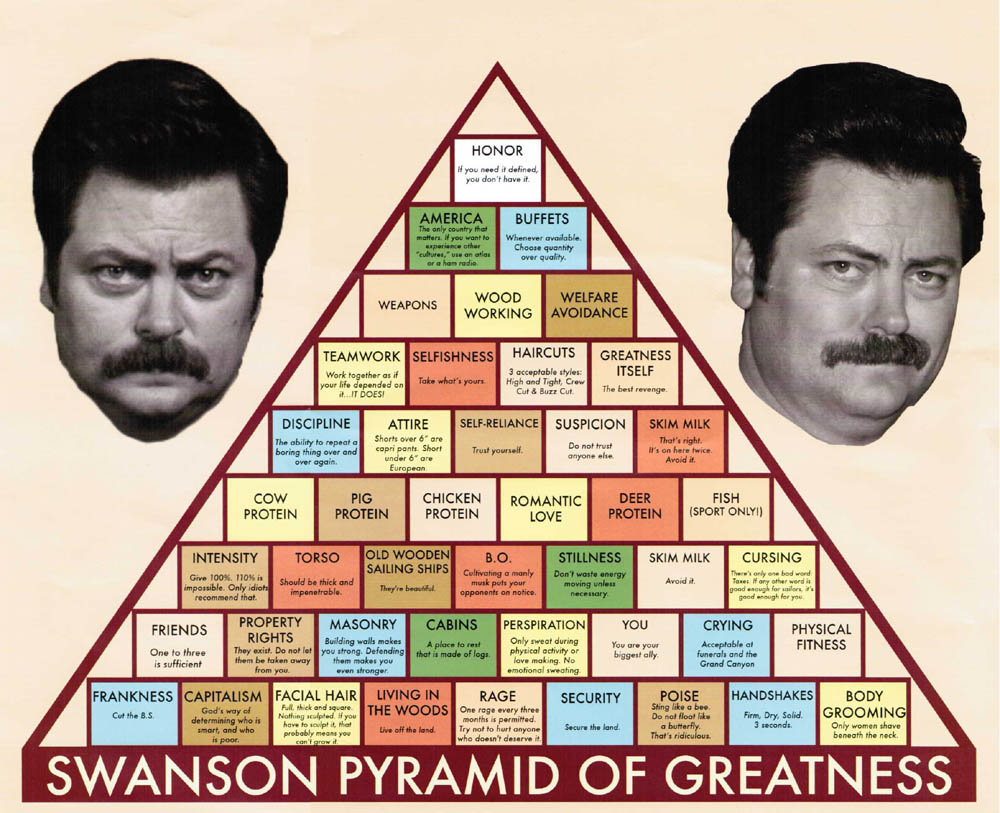
- Rob Lowe nails that "Anne Perkins!" finger point. It has somehow become sweet rather than bizarre.
-Wondering when Leslie and Ben fuck already. Any guesses by which ep number? I've got six.
-Andy with his hair matted down to impress April was adorably sad, the flowers didn't help either.
-Did I mention that chair throw, that was awesome for fans of the Knight.
Saturday, January 15, 2011
Random Pop Culture Top Ten List:: Top Ten Songs From Children's Movies Better Understood By Adults
By Jordan, Sam, and Ashley
Random Pop Culture Top 10 List is a (fairly self-explanatory) weekly list in which the writers at Review to Be Named take stock of the realm of pop culture, and come up with their Top Ten in a specific category.
A surprising amount of kids movies have musical numbers exploring themes that are either inappropriate for children or deal with themes that kids coul not hope to understand. Here are ten songs from kids movies that you probably appreciate (or understand) more now that you're slightly older:
10. "Can You Feel The Love Tonight" from The Lion King
Though the song sounds like less of a babymaking anthem when performed by Kristle Edwards rather than Elton John, the sexy jam "Can You Feel the Love Tonight" imparts two messages of questionable veracity to children: first, that lions are monogamous, and second, that your friends will secretly mourn every time you get laid. While the latter contains a kernel of truth (significant others will cut into time spent hanging out with the lazy, farting dudes you count as friends), only furries believe that smitten lions make sweet, passionate love in secluded jungle paradises. Mostly, it's anonymous and aggressive fucking in tall grass at midday, which is sure to be a rude awakening for your children when they stumble across it on Animal Planet and wonder why Simba is hurting Nala.
9. "Tale As Old As Time" from Beauty and the Beast
The definition of "snack break" moment for a lot of kids when they first see Beauty and the Beast, "Tale As Old As Time" is actually a pretty insightful song about contempt slowly melting into love. The routine is an old one for fans of romance films, but the most we ever got out of it as kids was that Mrs. Potts voice was pretty comforting (and that it was pretty impressive that the Beast could fit into that suit). In hindsight, watching the Beast try to be a gentlemen and finally make progress with Belle to a song about the romantic formula at its sweetest is actually a pretty affecting moment, but for a kid, its mostly just time to make a run for the peanut butter.
8. "Worried Shoes" from Where The Wild Things Are
Walking into Where The Wild Things Are as a kid, "Worried Shoes" probably comes across as a cute little song about some anthropomorphic shoes. It isn't. In fact, "Worried Shoes" comes from the mind of Daniel Johnston (though to be fair, the version in the film is a cover by Karen O) and is about his crippling depression, caused mostly by his fairly severe mental illness. The song comes from a place of deep darkness, a raw emotional examination of the shackles Johnston has to walk around with each day. It still fits with the tone of the film pretty well, but its inconceivable that any child seeing the movie would even begin to understand the song in context. And it works much, much better in context.
7. "I Won't Say I'm In Love" from Hercules
Anyone who has gone through their teens (or, let's be honest people, our early adulthood) knows what its like to hate yourself for loving someone. Attraction is an uncontrollable phenomenon and at least once in your life, you've probably fallen in love (or lust) with someone that probably wasn't the best choice for you. But our guess is that time wasn't in the third grade. Like many songs on this list, "I Won't Say I'm In Love" is actually very good and discusses some pretty complicated issues. They just happen to be issues that no one in the movie's age group would have any experience with, or any real knowledge of. there were talking statues there though, so bonus points for that.
6. "Hellfire" from The Hunchback of Notre Dame
Let's start with the obvious: a lot of children probably don't have a very good conception of Hell. More importantly though, we can't imagine too many of the films younger viewers understood the racial tension that plagued Frolo, nor his hate-fuck fueled desire to bang Esmerelda or possibly burn her at the stake for being a gypsy. There are a lot of problems with The Hunchback of Notre Dame (among them the fact that it basically teaches kids that ugly people never get the girl, a truism they can probably wait until puberty to discover), but Frolo's attraction to Esmerelda is the kind of dark, twisted, complex material better saved for a cable channel drama, not a villainous interlude in a movie with talking gargoyles.
5. "Pink Elephants on Parade" from Dumbo
In defense of "Pink Elephants on Parade," it is a pretty accurate assessment of what's going on in the film at the time. Yet what's going on in this children's movie is a talking elephant and his circus-hand mouse friend on a bender. This alone is inappropriate enough for kids, but even if they understand Dumbo's very poor decision, they probably won't get that the pink elephant is a well known metaphor for alcohol consumption and addiction. Adults may chuckle at the trippy ode to the paciderm on so many of their backs, but for kids this is really a combination of a bad influence and a bad trip...which is also something they probably won't know about for a decade or so after they see Dumbo.
4. "Little Drop of Poison" from Shrek 2
Shrek 2 is packed to the gills with jokes that play more to adults than to children. In fact, the movie probably wouldn't work at all as kid's fare if it weren't for a lot of cute anthropomorphic animals and some flatulence humor. Yet perhaps the most egregious (at least to the watchful viewer) is the song that Captain Hook sings in the tavern that houses all of the villains Prince Charming is trying to recruit. Technically "Little Drop of Poison" wasn't written for the movie (it actually appears on the kid-friendly Tom Waits' 2006 rarities collection Orphans: Brawlers, Bawlers, and Bastards), and that's obvious if you listen to the incredibly nihilistic, cynical lyrics. "Did the Devil make the world while God was sleeping?" Waits asks. A valid question perhaps for a late night philosophy session in a college dorm, but probably not one that most 6-year-olds are thinking about during that tag game at recess.
3. "Let Me Be Good to You" from The Great Mouse Detective
The sultry dame seducing the rowdy bar is a film noir staple dating back to the '30s. Yet this sequence from The Great Mouse Detective has a lot more that kids might not understand than just a seemingly meek mouse letting go and working her mojo on some rowdy mice. Sure there's drinking, but there's also a rohypnol joke as Basil's partner chugs a mug of beer that Basil warns him too late has been drugged. Let's run this down again: a temptress mouse keeps the bar full of murderous gangsters (dressed mostly as pirates, because I guess kids get that pirates are notorious alcoholics) from rioting by implying that she will sexually please all of them, a trick that isn't going to work on our stalwart heroes until they are drugged. This movie was rated G, but probably just because no kid is going to understand quite how fucked up and inappropriate this scene actually is until they look back on it years later.
2. "I Will Go Sailing No More" from Toy Story
One of the reasons Pixar's output is so good is that their films never talk down to kids. Hell, Toy Story 3 actually had the heroes facing their own mortality, and Up was pretty much a movie about death and the struggle to move on. So it can be argued that "I Will Go Sailing No More," the Randy Newman song that backs Buzz Lightyear's realization that he really can't fly, was just the prototype for this frank, mature way of engaging children. And while the song certainly works as just a sad song playing while something sad is happening to Buzz, its much more tragic when you realize that Newman is singing about the moment in your life when you realize, once and for all, that your dreams may not come true and that the world is a colder, harsher place than you ever expected. "I Will Go Sailing No More" is a legitimately great tragedy of a song, and we just didn't grasp the weight of its sorrow fully when we all still thought we'd grow up to be the first President to set foot on the moon and play a show there with our totally awesome band.
1. "Rainbow Connection" from The Muppet Movie
Seeing The Muppet Movie as a kid, "Rainbow Connection" just played as a sweet little song that showed us that Kermit had the talent he needed to impress Dom Deluise's Hollywood Agent and start his quest to strike it big in the land of dreams. Yet taking a closer look as an adult, "Rainbow Connection" is actually a song about the lies we tell ourselves to make us think our dreams can come true and works more to illustrate how unhappy Kermit is in his quiet swamp life before he realizes that he has to follow his long shot dream or else watch his spirit slowly die. But, you know, there's a stand-up comedian bear about five minutes in his future (at another shady bar full of murderous louts), so he's going to be fine. "Rainbow Connection" isn't the only song in the movie we didn't completely get as kids ("Can You Picture That," the trippy introduction of Dr. Teeth and The Electric Mayhem, and Gonzo's tragic, nostalgic "I'm Going To Go Back there Someday" leap immediately to mind) but it is the only one that takes on a completely new, much deeper meaning when reexamined at an older age.
Read more Random Pop Culture Top Ten List here
Random Pop Culture Top 10 List is a (fairly self-explanatory) weekly list in which the writers at Review to Be Named take stock of the realm of pop culture, and come up with their Top Ten in a specific category.
A surprising amount of kids movies have musical numbers exploring themes that are either inappropriate for children or deal with themes that kids coul not hope to understand. Here are ten songs from kids movies that you probably appreciate (or understand) more now that you're slightly older:
10. "Can You Feel The Love Tonight" from The Lion King
Though the song sounds like less of a babymaking anthem when performed by Kristle Edwards rather than Elton John, the sexy jam "Can You Feel the Love Tonight" imparts two messages of questionable veracity to children: first, that lions are monogamous, and second, that your friends will secretly mourn every time you get laid. While the latter contains a kernel of truth (significant others will cut into time spent hanging out with the lazy, farting dudes you count as friends), only furries believe that smitten lions make sweet, passionate love in secluded jungle paradises. Mostly, it's anonymous and aggressive fucking in tall grass at midday, which is sure to be a rude awakening for your children when they stumble across it on Animal Planet and wonder why Simba is hurting Nala.
9. "Tale As Old As Time" from Beauty and the Beast
The definition of "snack break" moment for a lot of kids when they first see Beauty and the Beast, "Tale As Old As Time" is actually a pretty insightful song about contempt slowly melting into love. The routine is an old one for fans of romance films, but the most we ever got out of it as kids was that Mrs. Potts voice was pretty comforting (and that it was pretty impressive that the Beast could fit into that suit). In hindsight, watching the Beast try to be a gentlemen and finally make progress with Belle to a song about the romantic formula at its sweetest is actually a pretty affecting moment, but for a kid, its mostly just time to make a run for the peanut butter.
8. "Worried Shoes" from Where The Wild Things Are
Walking into Where The Wild Things Are as a kid, "Worried Shoes" probably comes across as a cute little song about some anthropomorphic shoes. It isn't. In fact, "Worried Shoes" comes from the mind of Daniel Johnston (though to be fair, the version in the film is a cover by Karen O) and is about his crippling depression, caused mostly by his fairly severe mental illness. The song comes from a place of deep darkness, a raw emotional examination of the shackles Johnston has to walk around with each day. It still fits with the tone of the film pretty well, but its inconceivable that any child seeing the movie would even begin to understand the song in context. And it works much, much better in context.
7. "I Won't Say I'm In Love" from Hercules
Anyone who has gone through their teens (or, let's be honest people, our early adulthood) knows what its like to hate yourself for loving someone. Attraction is an uncontrollable phenomenon and at least once in your life, you've probably fallen in love (or lust) with someone that probably wasn't the best choice for you. But our guess is that time wasn't in the third grade. Like many songs on this list, "I Won't Say I'm In Love" is actually very good and discusses some pretty complicated issues. They just happen to be issues that no one in the movie's age group would have any experience with, or any real knowledge of. there were talking statues there though, so bonus points for that.
6. "Hellfire" from The Hunchback of Notre Dame
Let's start with the obvious: a lot of children probably don't have a very good conception of Hell. More importantly though, we can't imagine too many of the films younger viewers understood the racial tension that plagued Frolo, nor his hate-fuck fueled desire to bang Esmerelda or possibly burn her at the stake for being a gypsy. There are a lot of problems with The Hunchback of Notre Dame (among them the fact that it basically teaches kids that ugly people never get the girl, a truism they can probably wait until puberty to discover), but Frolo's attraction to Esmerelda is the kind of dark, twisted, complex material better saved for a cable channel drama, not a villainous interlude in a movie with talking gargoyles.
5. "Pink Elephants on Parade" from Dumbo
In defense of "Pink Elephants on Parade," it is a pretty accurate assessment of what's going on in the film at the time. Yet what's going on in this children's movie is a talking elephant and his circus-hand mouse friend on a bender. This alone is inappropriate enough for kids, but even if they understand Dumbo's very poor decision, they probably won't get that the pink elephant is a well known metaphor for alcohol consumption and addiction. Adults may chuckle at the trippy ode to the paciderm on so many of their backs, but for kids this is really a combination of a bad influence and a bad trip...which is also something they probably won't know about for a decade or so after they see Dumbo.
4. "Little Drop of Poison" from Shrek 2
Shrek 2 is packed to the gills with jokes that play more to adults than to children. In fact, the movie probably wouldn't work at all as kid's fare if it weren't for a lot of cute anthropomorphic animals and some flatulence humor. Yet perhaps the most egregious (at least to the watchful viewer) is the song that Captain Hook sings in the tavern that houses all of the villains Prince Charming is trying to recruit. Technically "Little Drop of Poison" wasn't written for the movie (it actually appears on the kid-friendly Tom Waits' 2006 rarities collection Orphans: Brawlers, Bawlers, and Bastards), and that's obvious if you listen to the incredibly nihilistic, cynical lyrics. "Did the Devil make the world while God was sleeping?" Waits asks. A valid question perhaps for a late night philosophy session in a college dorm, but probably not one that most 6-year-olds are thinking about during that tag game at recess.
3. "Let Me Be Good to You" from The Great Mouse Detective
The sultry dame seducing the rowdy bar is a film noir staple dating back to the '30s. Yet this sequence from The Great Mouse Detective has a lot more that kids might not understand than just a seemingly meek mouse letting go and working her mojo on some rowdy mice. Sure there's drinking, but there's also a rohypnol joke as Basil's partner chugs a mug of beer that Basil warns him too late has been drugged. Let's run this down again: a temptress mouse keeps the bar full of murderous gangsters (dressed mostly as pirates, because I guess kids get that pirates are notorious alcoholics) from rioting by implying that she will sexually please all of them, a trick that isn't going to work on our stalwart heroes until they are drugged. This movie was rated G, but probably just because no kid is going to understand quite how fucked up and inappropriate this scene actually is until they look back on it years later.
2. "I Will Go Sailing No More" from Toy Story
One of the reasons Pixar's output is so good is that their films never talk down to kids. Hell, Toy Story 3 actually had the heroes facing their own mortality, and Up was pretty much a movie about death and the struggle to move on. So it can be argued that "I Will Go Sailing No More," the Randy Newman song that backs Buzz Lightyear's realization that he really can't fly, was just the prototype for this frank, mature way of engaging children. And while the song certainly works as just a sad song playing while something sad is happening to Buzz, its much more tragic when you realize that Newman is singing about the moment in your life when you realize, once and for all, that your dreams may not come true and that the world is a colder, harsher place than you ever expected. "I Will Go Sailing No More" is a legitimately great tragedy of a song, and we just didn't grasp the weight of its sorrow fully when we all still thought we'd grow up to be the first President to set foot on the moon and play a show there with our totally awesome band.
1. "Rainbow Connection" from The Muppet Movie
Seeing The Muppet Movie as a kid, "Rainbow Connection" just played as a sweet little song that showed us that Kermit had the talent he needed to impress Dom Deluise's Hollywood Agent and start his quest to strike it big in the land of dreams. Yet taking a closer look as an adult, "Rainbow Connection" is actually a song about the lies we tell ourselves to make us think our dreams can come true and works more to illustrate how unhappy Kermit is in his quiet swamp life before he realizes that he has to follow his long shot dream or else watch his spirit slowly die. But, you know, there's a stand-up comedian bear about five minutes in his future (at another shady bar full of murderous louts), so he's going to be fine. "Rainbow Connection" isn't the only song in the movie we didn't completely get as kids ("Can You Picture That," the trippy introduction of Dr. Teeth and The Electric Mayhem, and Gonzo's tragic, nostalgic "I'm Going To Go Back there Someday" leap immediately to mind) but it is the only one that takes on a completely new, much deeper meaning when reexamined at an older age.
Read more Random Pop Culture Top Ten List here
Thursday, December 30, 2010
Feature: Sam's Top Ten of 2010
Here’s my top ten of 2010 list and it should be noted I never got around to seeing The Kids Are All Right and The King’s Speech. Who knows how this list could be different! Of course this is made up of what I did get around to seeing and I’ll stick by it.
10. Greenberg
In Noah Baumbach’s latest film, we follow a depressed 40 something trying to get his life together. Pretty standard small movie material but Ben Stiller delivers a great performance to match Baumbach’s script. The film never dives off the deep end to become maudlin but it toes the line following the lost Greenberg and his equally lost quasi-love interest Florence (another great performance from Greta Gerwig). If nothing else this movie made my list for having one of my favorite lines of the year.
9. Restrepo
While Exit Through the Gift Shop may have been my favorite documentary of the year, Restrepo might be the best. Placing viewers in the single most dangerous outpost in Afghanistan, Restrepo presents a war that is baffling on a number of levels. The soldiers, while they are more than capable and seem to firmly believe in the effort, are put in an unwinnable spot. They get constant complaints from village elders while they’re being shot at. In my view, the film makes the case against the United States being there since there seems to be no real point (other than of course to kill members of the Taliban). The film does an excellent job a putting real people to the war replacing a faceless view on out soldiers and the people in Afghanistan. Gripping and sometimes difficult to watch, Restrepo gives the best inside look to the war I’ve ever seen.
8. Shutter Island
Remember this? Yeah, it was released early in the year when much worse films are the norm. But Scorsese’s supernatural (kinda) thriller was a lot of fun and at times even beautiful. It’s been a while since seeing it but one thing I do remember about a lot of people’s reactions was that they could “call” the ending. I don’t think that was much of the point. It was about the journey for DiCaprio’s character rather than the audience being able to put the pieces together themselves. In this regard I think the film was a success, if you wanted a tougher mystery to crack, watch Memento or something.
7. Winter’s Bone
This was a difficult move to place for me. Winter’s Bone has been praised by critics and rightly so. The film has amazing performances from Sarah Lawrence and John Hawkes in this adaptation of a story of a girl looking for her father in the destitute Ozarks. Director Debra Granik gives a tremendous sense of place holding shots on seemingly innocuous items strewn about porches and front lawns. Winter’s Bone is this year’s “Little movie that could” in a lot of respects. The person to benefit most from this is Lawrence who was truly the breakout star.
6. Exit through the Gift Shop
In this fascinating documentary, Banksy, the acclaimed street artists, creates a documentary about a man who had spent years documenting him. The film works on two levels. First, it gives novices like me a rudimentary knowledge of the world of street art and artists like Banksy, Shepard Fairey and Space Invader. Just watching some of these artists work at night in sometimes dangerous situations and places is often as impressive as the final work. The other success of the film is documenting the life of Thierry Guetta whose footage makes for most of the film. Banksy examines Guetta’s interest in street art and his eventual foray into the fold as a known commodity in the street art world. Banksy also manages to lampoon him and make clear the line between ingenuity and borderline plagiarism.
5. Inception
I can’t help but think that Inception began to be viewed as something other than a great summer movie. Once people started projecting Oscar aspirations, in my mind, is when the backlash hit. Some found it boring, which I still find hard to believe. Others found it confusing, which I find even harder to believe. DiCaprio gives a solid performance but nothing Oscar-worthy. The real standouts were Marion Cotillard and Joseph Gordon Levitt. Great special affects along with well above average action makes for what I think is the best summer film since Nolan’s The Dark Knight. Even for Inception detractors I find it difficult for someone to make an argument that it doesn’t serve as a great summer blockbuster. Oscar winner? Perhaps not. But Inception is the type of fun that I want in my summer viewing.
4. True Grit
I’ll always have a soft spot for Joel and Ethan Coen as they may be my favorite living directors. True Grit is somewhat of a departure for the brothers as it is really just a straight Western. It also continues a new trend of theirs of adapting films from books (No Country for Old Men being the first, I don’t count O Brother Where Art Thou?). What makes True Grit so enjoyable is the cast lead by Jeff Bridges who plays Rooster Cogburn and newcomer Hailee Steinfeld who plays Mattie Ross who looks to avenge her father’s death. Steinfeld’s performance should garner her an Oscar nomination and will likely put her up against another young actress, Winter’s Bone’s Jennifer Lawrence. Of course the Coens made a supremely crafted film even if it is a bit less off kilter than their others.
3. The Social Network
Besides having the best trailer of the year (hmm that would have made an interesting list) The Social Network had by far my favorite screenplay coming from one of my favorite writers, Aaron Sorkin. Yes, many of the details were not true to the real story of Facebook or Mark Zuckerberg (portrayed wonderfully awkward by Jesse Eisenberg). Though to take the narrative as it stands in the movie, it’s truly great. There were a number of comparisons to Citizen Kane in the sense that it portrays the rise to power of a media mogul who essentially ostracizes himself from everyone he has cared about, but that may be a bit of a stretch. This much is true, The Social Network was way better than any movie about Facebook has any right to be.
2. Toy story 3
Every college student must feel the same way about the conclusion of the Toy Story franchise. It’s like it was timed out perfectly for us. We watched the first one when we were Andy’s age then in the most recent incarnation he was a college bound young adult. What I continually to be impressed by with Pixar, besides its top of the industry CGI films, is their boldness in taking on darker parts of life in their films. Of course TS3 is still kid friendly but it deals with moving on to another stage in your life. Something, to me anyways, that can be scary. The voice cast was once again excellent with the best addition being Michael Keaton’s Ken doll. My only real complaint is little and that’s Slinky Dog who was voiced by the late Jim Varney was replaced.
1. Black swan
Whatever you think of Darren Aronofsky, he always goes for broke and seems pretty unapologetic about it. I think Black Swan is his masterpiece, better than even the oft acclaimed Requiem for a Dream. What may have been this film’s downfall is how transparent the connections to the ballet Swan Lake were. But the movie overcomes that in my mind. Reaction to the clear symbols in the movie may be the deciding factor in whether one loves or loathes Black Swan. Natalie Portman gives the best performance of her life while Mila Kunis, Barbara Hershie and Vicent Cassell provide wonderful support. In debt to “slipping into madness” films like The Red Shoes especially, Black Swan still felt wholly original and delivered an exciting end to the year in movies.
10. Greenberg
In Noah Baumbach’s latest film, we follow a depressed 40 something trying to get his life together. Pretty standard small movie material but Ben Stiller delivers a great performance to match Baumbach’s script. The film never dives off the deep end to become maudlin but it toes the line following the lost Greenberg and his equally lost quasi-love interest Florence (another great performance from Greta Gerwig). If nothing else this movie made my list for having one of my favorite lines of the year.
9. Restrepo
While Exit Through the Gift Shop may have been my favorite documentary of the year, Restrepo might be the best. Placing viewers in the single most dangerous outpost in Afghanistan, Restrepo presents a war that is baffling on a number of levels. The soldiers, while they are more than capable and seem to firmly believe in the effort, are put in an unwinnable spot. They get constant complaints from village elders while they’re being shot at. In my view, the film makes the case against the United States being there since there seems to be no real point (other than of course to kill members of the Taliban). The film does an excellent job a putting real people to the war replacing a faceless view on out soldiers and the people in Afghanistan. Gripping and sometimes difficult to watch, Restrepo gives the best inside look to the war I’ve ever seen.
8. Shutter Island
Remember this? Yeah, it was released early in the year when much worse films are the norm. But Scorsese’s supernatural (kinda) thriller was a lot of fun and at times even beautiful. It’s been a while since seeing it but one thing I do remember about a lot of people’s reactions was that they could “call” the ending. I don’t think that was much of the point. It was about the journey for DiCaprio’s character rather than the audience being able to put the pieces together themselves. In this regard I think the film was a success, if you wanted a tougher mystery to crack, watch Memento or something.
7. Winter’s Bone
This was a difficult move to place for me. Winter’s Bone has been praised by critics and rightly so. The film has amazing performances from Sarah Lawrence and John Hawkes in this adaptation of a story of a girl looking for her father in the destitute Ozarks. Director Debra Granik gives a tremendous sense of place holding shots on seemingly innocuous items strewn about porches and front lawns. Winter’s Bone is this year’s “Little movie that could” in a lot of respects. The person to benefit most from this is Lawrence who was truly the breakout star.
6. Exit through the Gift Shop
In this fascinating documentary, Banksy, the acclaimed street artists, creates a documentary about a man who had spent years documenting him. The film works on two levels. First, it gives novices like me a rudimentary knowledge of the world of street art and artists like Banksy, Shepard Fairey and Space Invader. Just watching some of these artists work at night in sometimes dangerous situations and places is often as impressive as the final work. The other success of the film is documenting the life of Thierry Guetta whose footage makes for most of the film. Banksy examines Guetta’s interest in street art and his eventual foray into the fold as a known commodity in the street art world. Banksy also manages to lampoon him and make clear the line between ingenuity and borderline plagiarism.
5. Inception
I can’t help but think that Inception began to be viewed as something other than a great summer movie. Once people started projecting Oscar aspirations, in my mind, is when the backlash hit. Some found it boring, which I still find hard to believe. Others found it confusing, which I find even harder to believe. DiCaprio gives a solid performance but nothing Oscar-worthy. The real standouts were Marion Cotillard and Joseph Gordon Levitt. Great special affects along with well above average action makes for what I think is the best summer film since Nolan’s The Dark Knight. Even for Inception detractors I find it difficult for someone to make an argument that it doesn’t serve as a great summer blockbuster. Oscar winner? Perhaps not. But Inception is the type of fun that I want in my summer viewing.
4. True Grit
I’ll always have a soft spot for Joel and Ethan Coen as they may be my favorite living directors. True Grit is somewhat of a departure for the brothers as it is really just a straight Western. It also continues a new trend of theirs of adapting films from books (No Country for Old Men being the first, I don’t count O Brother Where Art Thou?). What makes True Grit so enjoyable is the cast lead by Jeff Bridges who plays Rooster Cogburn and newcomer Hailee Steinfeld who plays Mattie Ross who looks to avenge her father’s death. Steinfeld’s performance should garner her an Oscar nomination and will likely put her up against another young actress, Winter’s Bone’s Jennifer Lawrence. Of course the Coens made a supremely crafted film even if it is a bit less off kilter than their others.
3. The Social Network
Besides having the best trailer of the year (hmm that would have made an interesting list) The Social Network had by far my favorite screenplay coming from one of my favorite writers, Aaron Sorkin. Yes, many of the details were not true to the real story of Facebook or Mark Zuckerberg (portrayed wonderfully awkward by Jesse Eisenberg). Though to take the narrative as it stands in the movie, it’s truly great. There were a number of comparisons to Citizen Kane in the sense that it portrays the rise to power of a media mogul who essentially ostracizes himself from everyone he has cared about, but that may be a bit of a stretch. This much is true, The Social Network was way better than any movie about Facebook has any right to be.
2. Toy story 3
Every college student must feel the same way about the conclusion of the Toy Story franchise. It’s like it was timed out perfectly for us. We watched the first one when we were Andy’s age then in the most recent incarnation he was a college bound young adult. What I continually to be impressed by with Pixar, besides its top of the industry CGI films, is their boldness in taking on darker parts of life in their films. Of course TS3 is still kid friendly but it deals with moving on to another stage in your life. Something, to me anyways, that can be scary. The voice cast was once again excellent with the best addition being Michael Keaton’s Ken doll. My only real complaint is little and that’s Slinky Dog who was voiced by the late Jim Varney was replaced.
1. Black swan
Whatever you think of Darren Aronofsky, he always goes for broke and seems pretty unapologetic about it. I think Black Swan is his masterpiece, better than even the oft acclaimed Requiem for a Dream. What may have been this film’s downfall is how transparent the connections to the ballet Swan Lake were. But the movie overcomes that in my mind. Reaction to the clear symbols in the movie may be the deciding factor in whether one loves or loathes Black Swan. Natalie Portman gives the best performance of her life while Mila Kunis, Barbara Hershie and Vicent Cassell provide wonderful support. In debt to “slipping into madness” films like The Red Shoes especially, Black Swan still felt wholly original and delivered an exciting end to the year in movies.
Subscribe to:
Posts (Atom)